

Nepal is a fantastic country with, in our opinion, the most beautiful mountains in the world. An opinion I have shared repeatedly and at great length in our many Nepal hiking posts, most recently in our long, detailed – and yet unfortunately incomplete due to weather – guide to trekking the Manaslu Circuit. Which is why we have visited this far-flung Asian country 5 times now, and why I feel that even though we are far from experts on the place, we do have some useful insight to share regarding things to know about Nepal.
And, of course, this being Routinely Nomadic and all, we also have quite a few useless insights to share as well. Feel free to enjoy both.
Things to Know Before Visiting Nepal
Our site includes affiliate links to products we recommend. If you use one to make a purchase, we earn a small commission at no extra cost to you. Thanks for your support!
Nepal is both figuratively and geographically on the completely opposite side of the world from Saskatchewan, a whopping 11,000 km away, to be exact. Which, in layman’s terms, is pretty far.
So, obviously, their time zone is considerably different, as well. My question is, does it have to be QUITE so different? I mean, 15 minutes (!) ahead of India? That feels a bit unnecessary, and more than a little passive aggressive.
Nepal is famous (to us) for its insane and frustrating bureaucracy, especially entering and exiting the country. The bright side? You can now apply for your visa online ahead of time and save a lot of time and hassle at the airport. Downside? You still need to wait in line to pay for it at the airport – $US50 paid either by cash (they are REALLY hoping you choose this option) or by credit card with a fee “anywhere from 3 to 15%”. Which seems like an impractically large range. For what it’s worth, we were charged 3.78%.

On a related note, many places in Nepal will charge you a fee to pay with credit card, usually 3-5%. But, considering the high ATM fees and low withdrawal limits, this is still usually a reasonable option.
However, if you are planning to do a multi-day hike in the mountains – and you should be, obviously – you will need to pay for everything along the trek with cash. Which, for a 2-week hike, means a lot of withdrawals. And, since their largest bill is just 1,000 rupees ($US7) be ready to pack a separate bag just for your big, nasty stash of cash.

Kathmandu is still just as chaotic and overwhelming as ever, especially the tourist area of Thamel, although the smog seems somewhat improved. Probably at least somewhat due to the huge influx of electric vehicles. Much better for air quality. But dangerously quiet on the insanely crowded streets. It took me barely 15 minutes to get clipped by a sneaky mirror.

Despite the booming EV business, Nepal’s embrace of climate conscious measures still does not, apparently, extend to plastic water bottles. They do have 20L reusable jugs, like most places. The next largest size, however? 1-litre. Let’s just say, those can add up pretty fast. Yet another reason we always carry Aquatabs for treating water.
Beer is relatively expensive in Nepal. Relative to other things in Nepal, not to the price of beer in, say, London or at a hockey game in Canada. Roughly $US5-7 per large beer. On the bright side, I quite enjoy the Barahsinghe, a relatively new addition to the Nepalese booze scene.

The first couple times we visited Nepal there were daily power outages and extensive brownout schedules. This no longer seems to be a big issue, though, which is great. Maybe it has something do with their highly efficient and clearly foolproof power grids:

We’re not huge fans of Nepalese food, although I do enjoy the “chili chicken” with rice and we both find the fried noodles and fried rice functional, if not inspiring. But we’ve never really got on board with the ever-popular “dal bhat”, famous from all those t-shirts you’ll see promising “dal bhat power / 24-hour”. Funny because it rhymes, you see. In fairness, dal bhat actually is good hiking food and always offered in unlimited portions, great for both big eaters and garlic lovers. Neither of which describes us, unfortunately.

However, because Nepal is close to India (right beside it, you might say), their religions are quite intertwined and there are lots of Indian tourists, not surprisingly, there is also a lot of Indian food. All of which affected us to a certain extent. We really enjoyed the food part.

Plus, Laynni does have quite a fondness for Nepalese milk tea – comparable to Indian chai – and we both get very excited when offered Coke in a glass bottle. Especially when it comes with a kick-ass Vietnamese meal.

In Nepal, no matter where you are, what you are doing or what time of day or night it is, there will always be a dog barking nearby.
There are three different mobile companies in Nepal, making it easy (and cheap) to get a local SIM or eSIM. NCell is the network used by most eSims but Nepal Telecomm (NTC) still has much better coverage in the mountains so it is worth going to a local shop to get a physical NTC SIM if you’re planning to trek.

The roads in Nepal still suck. Like, truly. However, travelling the 7-9 hrs between Kathmandu and Pokhara you now have the option of taking a “luxury sofa bus”, a huge step up in comfort for a fairly minimal step up in price (around $US11). Equipped with shabby but comfortable velour laz-e-boy family room furniture in a spacious 2 & 1 formation, offering good views, free water, 2 bathroom breaks and 1 lunch break and not a single seat belt to restrict your freedom of movement. Whichever direction you’re headed, try to get seats on the north side (better views, less sun).

Kathmandu has so many pigeons. No, more than that. Most of them hang around the Durbar Square but, don’t worry, there will always be a few willing sit outside your hotel room window cooing night and day.

There are also rats, although hopefully you won’t see nearly as many of those. I did see one freshly dead one, quickly approached by an excited-looking crow who took one look, then went straight for the asshole. Not a moment’s hesitation. Clearly not his first rodeo.
Businesses in Nepal seem to have mastered the art (industry?) of the fake Google review. So take the overall ratings with a grain of salt, then sift through the individual reviews, ignoring any from “customers” who have posted fewer than 5 reviews. Also watch for anybody named John Smith using broken English.

Taxis are cheap in Nepal and we’d recommend getting set up on Pathao, their version of Uber. Unfortunately, you will have to pay in cash but the app is still good for ordering taxis and food delivery, or just getting an idea of an average price before heading out to negotiate with taxis in person.
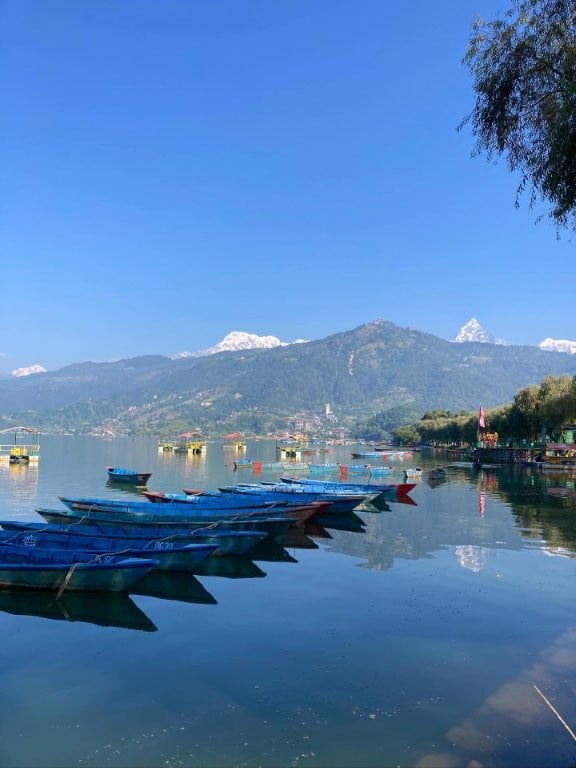
We much prefer Pokhara to Kathmandu. It has better mountain views, less traffic, better air quality, fewer people cooking chickens in back alleys with blowtorches and the really quite lovely Phewa Lake. There are many different ways to get out on the water, including SUPs that can be rented for roughly $US2/hour. Which is a great deal, obviously. Plus, nobody actually stands up on their “stand-up paddleboards”, which means you can look like a superhero simply by managing this most basic of skills.

The best times to trek in Nepal are either October-November or March-April. Early October and late April are riskier for rain, while early March and late November can be cold enough to freeze the balls off a marmot, as they say (although they don’t). Which leaves you with 2 months, essentially. And we personally like fall better because the air is clearer following the rainy season. So just the 1 month, I guess. Super flexible.

Most Nepali showers are not separated from the rest of the bathroom, essentially making the entire room one big shower. Which, unfortunately, is not as cool as it sounds. Keep that TP in a safe place.
Also, just assume you can never flush toilet paper, even though they never mention it and rarely put up signs. They do provide a bin at least, so it’s not as though you’ll have to take it with you.

Almost every corner shop in Pokhara or Thamel will do your laundry, usually recognizable by the dryer right next to the sidewalk constantly in action in order to demonstrate that they do, in fact, have the ability to finish your laundry in “3-hours!” as advertised.
Nepal has truly mastered the art of secure plastic packaging. We literally couldn’t open anything without scissors. Including bags of chips. Except for that one time in the airport I resorted to sitting on it to make it pop. Success! But only in the one basic way. In every other way it was a disastrous mess.

Summary
So, as you can probably tell from reading this list, we don’t actually know EVERYTHING about Nepal. However, you’d also have to admit that we clearly know SOME things. Whether those things are useful or not is debatable but, nonetheless, now you’ve read them and you can’t really UNread them soooo… you’re welcome?
Enjoy your trip!
Pin it for Later!

Other Posts You Might Like:
Manaslu Circuit: Everything to Know Before Your Trek
Gokyo Lakes Trek: A Spectacular Everest Base Camp Alternative
The Best and Worst of the Annapurna Circuit
The Annapurna Base Camp Morning Show!
Tour du Mont Blanc or Everest Base Camp?
Thailand: Things to Know Before Visiting
The Seven Lakes of the Tajikistan Fann Mountains FAQ
About the Author
Dean Johnston

Dean Johnston quit his job as a financial planner in 2008 to travel the world, and has now visited all 7 continents and more than 90 different countries. He wrote his first blog entry in a sweltering internet cafe in Bali in 2000 and has been writing about their travels ever since, including publishing 3 travel books.
As Routinely Nomadic, Dean remains focused on providing informative travel guides, entertaining stories and useful social media content to readers from all over the world.