

For years we’ve been telling anyone who will listen that Nepal has the best trekking in the world. Which is purely subjective, obviously, but it’s also not like we’re new to this. We’ve done a lot of cool hikes in a lot of cool places but when push comes to shove, it is just really hard to beat the giant peaks, clear air and colourful alpine lakes of the Himalayas. Which is exactly why we found ourselves back in Nepal for visit number 5, this time to tackle the vaunted Manaslu Circuit.
Lauded by some as “the most beautiful trek in Nepal”, which is quite a claim, considering the serious competition posed by such heavyweights as Everest Base Camp, Gokyo Lakes, Annapurna Circuit and Annapurna Base Camp. Just to name a few. For us, though, it wasn’t so much whether or not that statement was true, but simply that somebody out there felt that way meant it must be pretty good and unlike those others, we hadn’t tried the Manaslu Circuit yet.
Our site includes affiliate links to products we recommend. If you use one to make a purchase, we earn a small commission at no extra cost to you. Thanks for your support!
Unfortunately, now that we have, we are still unable to properly weigh in on the debate since, the mountains being mountains, we had some serious weather complications and were unable to complete the entire circuit (cue sad violin music). Yes, for awhile things were chugging along just fine, with our first 7 days spent in glorious sunshine, enjoying fabulous valley views at low altitude and later – up around 4,000m – marvelling at our first great looks at some of those big Himalayan peaks that make Nepal so famous. Wonderful!
Then, on day 8, you could sort of see the sky starting to shift. What, a few clouds, big deal, can’t be blue sky everyday, right? Then, in Samdo, just one overnight stop away from the daunting Larke Pass (5,160m), we were on our way back to our room at night when we noticed a few snowflakes gently – and seemingly harmlessly – floating down out of the dark night sky. Oh, how adorable, we thought. We’re really in the mountains now, we laughed.
Fast forward 8 hours or so, and there I am struggling to peel open my eyes while tucked tightly into my sleeping bag (it gets mighty cold up at those altitudes), eventually focusing on Laynni looking at me with – is that concern on her face? Hmm, doesn’t look like GOOD news, that’s for sure.
“Um, it snowed last night”
“Oh, yeah? Nice.”
“No, not nice. It snowed a LOT.”
“A LOT? Like how much?”
“A LOT.”
So, needless to say, that finally convinced me to shed the warmth of my down cocoon and take a peek for myself and, yeah, we’re talking a foot or two of snow. EVERYTHING was covered. And despite the early hour some local guys had already taken the time to make some snow sculptures right in front of our room. A few religious symbols, a few dicks, the usual.

Anyway, long story short, a huge and unseasonable snowstorm had blown in overnight despite the fact it was nearly the end of October and October to April is typically the dry season. Something to do with a cyclone off the coast of India, or maybe just generally less predictable climate patterns like everywhere else in the world, or maybe it had something to do with that one time we went around a Tibetan stupa counterclockwise instead of clockwise, because nobody was looking and it seemed a bit shorter. Who can say? In fairness, the forecast actually had shown a bunch of snow but I rarely trust mountain forecasts, especially when using foreign weather apps, because you never know exactly where they are taking their readings.

Anyway, who was to blame for the snow is not the point (probably Laynni, but we’re still debating this). The point was, despite a valiant effort, the trekkers up at Dharmasala, the last stop before the pass, were unable to fight through the even greater amount of snow up there and had to turn back. Which meant we also couldn’t go up to Dharmasala to prepare for our ascent. So, essentially, we were stuck. And the next question became, for how long? The forecast still did not look good.
And because we weren’t yet at the top, we would need to get at least 2 very nice days in row to make it possible for both us and the people above us to make it over. And if that didn’t happen, who knows how long we’d end up stuck there. So we weighed our options, calculated some odds, held some damp pinkies up to the wind, you know, scientific stuff. And decided to turn around and head back down the mountain from whence we’d come. And once the decision was made we saw no reason to linger and hit the trail immediately after breakfast.

Since Laynni and I both had micro-spikes and our guide did not, Laynni broke the trail for the first while with Anil behind her directing her to keep her from veering off (the trail was basically unrecognizable at this point – just a fluffy white carpet) and me trailing behind, I don’t know, keeping an eye out for bandits or wolves or something. Or so I pretended. Luckily, it wasn’t long before a large and even more eager hiking group caught up to us and we gladly waved them past, offloading the exhausting responsibility of trudging through the fresh snow.

And that is basically what we did for the next 2 and a half days. Although as we headed back down to lower elevations the snow slowly changed to rain and the ground from snowy to muddy – mixed, as always, with very generous portions of mule shit. We were briefly teased by a few hours of dwindling rain that led us to believe that the weather was turning in our favour (it wasn’t), and eventually left the trail, crossing a suspension bridge to an actual “road”, the highest point in the valley reachable by vehicle. Very sturdy, very 4WD vehicle only, but still.

With hundreds of hikers finally having come to the same conclusion as us, most slowly making their way down behind us, we were thrilled to find a spot in the box of one of the jeeps where we jammed in knee to knee with Ross and Lucy, an Australian couple we’d just met, and their guide Abbie, who was probably most responsible for us getting a ride in the first place. From there we battled through muddy dips, drove under ever-growing waterfalls, struggled through rushing streams and eventually made it to our starting point from 10 days prior, Machhakhola. And just in time, it seemed, as almost immediately we heard that the water had gotten too deep to traverse in spots, and that a number of landslides were now blocking the road and even wiping out the hiking trail. Timing is everything, as they say.

So, after one last night in Machhakhola, we were essentially out. Which was not the case for most, however. In the end, it took several days for the weather to calm down long enough for a group of local guides to clear a path over the pass. At which point people could only just START moving again. Meanwhile, landslides had stopped people from getting out the bottom for a couple days and the jeeps still weren’t running so even once it was possible to pass on foot, people still had to hike the whole way (an extra day and half on top of what we did). Except, of course, for those either willing to pay $US2000 for a helicopter rescue or who had a concerned government willing to arrange it for them. And, through it all, there were many injuries, many cases of altitude sickness, a lot of missed flights and we heard that some people even died in an avalanche, although not specifically on the Manaslu Circuit. A mess, is what it was.
So, despite the fact our plans were wildly disrupted and we weren’t able to complete the full Manaslu Circuit, missing out on reportedly epic views at the pass, we were happy to have had a fantastic week of mountain hiking before things went sideways, and feel VERY lucky to have made it out when we did. The end.

Well, that entire story essentially covers just ONE of the “things to know before trekking the Manaslu Circuit”. Basically, don’t try it in a blizzard. You’re welcome. Many more of those tasty nuggets to come. Although probably with a bit less preamble.
Because even though we didn’t finish the entire circuit, I don’t expect there is much difference in the logistics, guesthouses, food or planning processes on those last 3 days that we missed. So I think we can still provide some useful information and advice to help you plan your very own Manaslu Circuit trek.

So here we go, starting with the basics:
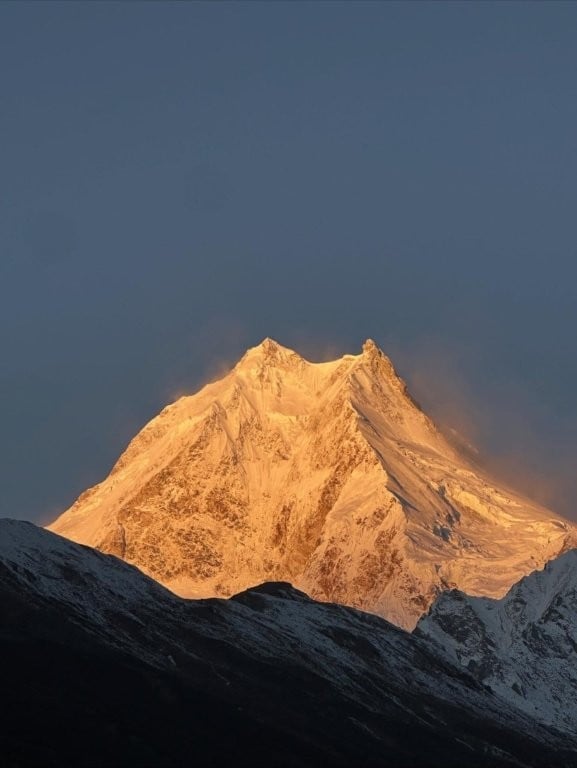
The Manaslu Circuit is an epic long-distance alpine hike that makes its way around Mount Manaslu which, at 8,163 metres, is the 8th tallest mountain in the world. Just one of many notable peaks you’ll see along with the following:
Annapurna II – 7,937 meters
Himalchuli – 7,893 meters
Ngadi Chuli – 7,871 meters
Shingri Himal – 7,083 meters
“Manaslu” comes from a Sanskrit word that means “spirit” or “soul”.
The Manaslu Circuit only opened to tourists in 1991.
It is known for its lush vegetation (even at high altitude), many waterfalls and impressive suspension bridges. And mountains, of course. It’s Nepal. There are always mountains.

The trek follows the Budi Gandaki river valley most of the way.
It is VERY close to Tibet. In fact, one of the most popular day hike add-ons is a trail that takes you right up to the Tibetan border.
Manaslu Circuit Map
Click the star to save this map to your Google Maps – then find it under Saved/Maps (mobile) or Your Places/Maps (desktop)
Manaslu Circuit Details
Start: Maccha Khola (900m)
Finish: Dharapani (1900m)
Duration: 10-14 days
Distance: 150 km / 52 hiking hrs (rough estimate depending on side trips)
Elevation Gain/Loss: (7,700m / 5,300m)
Highest Point: Larke La (5,160m)

We’ll start with some basic Manaslu info.
How Difficult is the Manaslu Circuit?
Usually the main difficulty of hikes in Nepal is the altitude. Once you get above 3,500m everything gets harder, even as the hiking distances become shorter. However, the Manaslu Circuit combines both of these wonderful challenges, with some very long and hard days in the beginning and all the difficulties of altitude later on. Through our first 3 days we covered roughly 60km with nearly 3,500m of elevation gain and 1,700m of elevation loss. Up and down, up and down. Plus, it was really hot. Quite the combo. Definitely the most difficult of the 5 treks we’ve done in Nepal, and we didn’t even make it over the pass.
In comparison to some of the other big treks we’ve done, it is probably on par with the Walker’s Haute Route in Switzerland or the Carros de Foc in the Spanish Pyrenees. In our opinion, it is more difficult than the Huayhuash Circuit in Peru, the Tour du Mont Blanc in France/Italy/Switzerland or the Alta Via 1 in the Italian Dolomites.
If, for some reason, that further piques your interest in long-distance hiking, you can check out the details on many of the other multi-day treks we’ve done around the world and read our specific post about the Best Long-Distance Hikes in Europe.
When to Hike the Manaslu Circuit
There are two main trekking seasons in Nepal, spring and fall. In our opinion, fall is best because the post-rainy season air is clearer (no dust) and the weather is (normally) more stable. The autumn trekking season used to run from the beginning of October to mid-November but in recent years climate change has made the end of the rainy season less predictable and most guides will recommend waiting until at least mid-October. And if you can handle the even colder temperatures, November and even early December are almost guaranteed to be dry and there will be far fewer trekkers sharing the trail.
In spring, March to mid-April is a good time, with late April being a bit riskier for rain and snow but generally possible.
Manaslu Circuit Costs and Prices
Nothing involved with trekking in Nepal is particularly expensive but there are quite a few different expenses and when you add them all together, it never ends up being quite as cheap as you expect. Well worth it, in our opinion, but not exactly a shoestring budget endeavour.
While it is technically possible to arrange everything on your own, local travel agencies do a far better job for a very reasonable markup. HI Nepal Treks in Pokhara organized everything for us and we were very happy with the price, communication and professionalism. We had Mohan arrange our permits, guide/porter and private jeep to and from the trail. We paid for our own teahouses and food as we went.

Or you can sign up for an all-inclusive tour, which includes your guesthouse fees and food costs. These inevitably cost more but the big advantage is you don’t have to pay for anything along the way or try to figure out exactly how much cash you need to carry.
Hikers on the Manaslu Circuit require three different permits.
$US100 Manaslu Restricted Area Permit (+$15/day beyond 7 days in the restricted area, not necessary unless doing a number of side trips)
$US30 Manaslu Conservation Area Permit
$US30 Annapurna Conservation Area Permit
Every trekker MUST have a guide now. They generally cost between $US30-50/day.
Porters are optional. There is nothing wrong with carrying your own gear but keep in mind that there are many Nepalis whose livelihoods depend on what they can earn during trekking season, and for most tourists the $US25-35/day it costs to hire a porter is a very reasonable price to pay to lighten their load and provide another job to a local.
We rented some of our gear – sleeping bags, micro-spikes, some extra gaiters and a better rain jacket for Laynni, another water bottle. And all of that cost about $US50 for the entire trek, so that is definitely an affordable option if you don’t want to bring everything you’ll need with you (or carry it on to your next destination).
Most people come from either Kathmandu (8-10 hrs) or Pokhara (6-7 hrs). You can take a local bus, which are fairly cheap, or you can hire a private jeep for anywhere from $US150-300. This should be one of the main questions you ask your travel agency.

The mountain huts, also called guesthouses or teahouses, are, in a word, cheap. The prices ranged from 650 rupees (less than $US5) for a basic plywood room with a shared toilet in the hall to 2000 rupees ($US15) for a big room with attached bath and hot shower (not that common).
Food is more expensive on the Manaslu Circuit than in the villages along the highway because everything needs to be transported up. Which is also why it gets more expensive the higher you go, especially after the road ends and everything is hauled in on the back of mules. We still wouldn’t call it expensive, though.

Just a few examples:
Fried eggs $US3-4
Fried noodles $US5-6
Tibetan bread $US3-4
Dal bhat (traditional all-you-can-eat spicy rice and curry dish) $US6-8
Beer $US3 (small) / $US6 (big)
We aren’t the biggest eaters, so keep that in mind, but we usually spent around $US15-20 per person per day on food.
You can buy bottled water if necessary, although basically everybody just treated the tap water – both cheaper and better for the environment. We used Aquatabs, as always, as did many others. Some people opted for LifeStraws or SteriPens, each of which work well also.
Planning Resources and Info
You don’t really need a map or guidebook to hike the Manaslu Circuit. You’ll have a guide, for starters. We still kept an offline copy of an AllTrails route just in case and it did come in handy now and then when we were walking separately from our guide.
The trail is marked, though not always well. At least there are signs at all major intersections and usually it will be busy enough that you can spot someone on the trail in front of you if you’re unsure.

We were pleasantly surprised by the strength of the cell service on the Manaslu Circuit. We bought physical NTC (Nepal Telecomm) SIM cards in Kathmandu and they served us well, working in almost every village. We really only had “no service” once or twice on the entire trek, although sometimes we had “E” which is basically useless as far as internet goes.
Most teahouses have wifi now (sometimes free, sometimes for $US2-4), although it was always pretty hit and miss, especially once the hut was full and everyone was trying to use it. We ended up using our phone data most of the time.
There are no ATMs along the Manaslu Circuit so you’ll need to carry enough cash for the entire hike. Which, for us, meant a lot of withdrawals in Pokhara and all the extortionate withdrawal fees that went with them. NABIL Bank let us take 30k at a time and the fees were slightly lower (650 rupees) than some of the other ATMs.
Manaslu Circuit Route Overview
Basically, you start way down in Machhakhola at 850m, hike for 8-9 days up a valley until you cross Larke Pass at 5,160m, then head steeply down to the village of Dharapani at 1,900m where you’ll either catch a jeep back to Pokhara or Kathmandu, or continue on to the epic – and epically famous – Annapurna Circuit.

Manaslu Circuit Itineraries
Of course, nothing is ever that simple. Your total trek will also be affected by the number of rest days, acclimatization hikes, side trips and variations you choose. Here are the most common stages, although there are plenty more teahouses in between that you can use to change your schedule or simply avoid the crowds a bit. The hiking hours are obviously variable depending the hiker and the conditions and they do NOT include breaks, which usually added up to a couple hours per day.
12-Day Manaslu Circuit Itinerary
1 Jeep from Kathmandu/Pokhara to Machhakhola (850m)
2 Macchakola-Jagat (1410m)
20km, 5-7 hrs, 850m gain / 300m loss
All valley walking, some great scenery, lots of up and down.

3 Jagat- Deng (1860m)
22km, 6-7 hrs, 1200m gain / 600m loss
Followed the dirt road, then crossed a cool bridge with 3 waterfalls next to it. Occasional angles of Shingri and Manaslu once or twice. The trail to head up the Tsum Valley is just before Deng.
4 Deng-Namrung (2660m)
19km, 6-8 hrs, 1400m gain / 800m loss
Morning was still in the valley and then after lunch we spent 3.5 hours mostly among big, mossy trees that reminded us of Vancouver Island. The last hour is almost entirely up stone steps (at least 500m), with a good stop for apple juice and baking.

5 Namrung-Shyala (3520m)
18km, 5-7 hrs, 950m gain / 200m loss
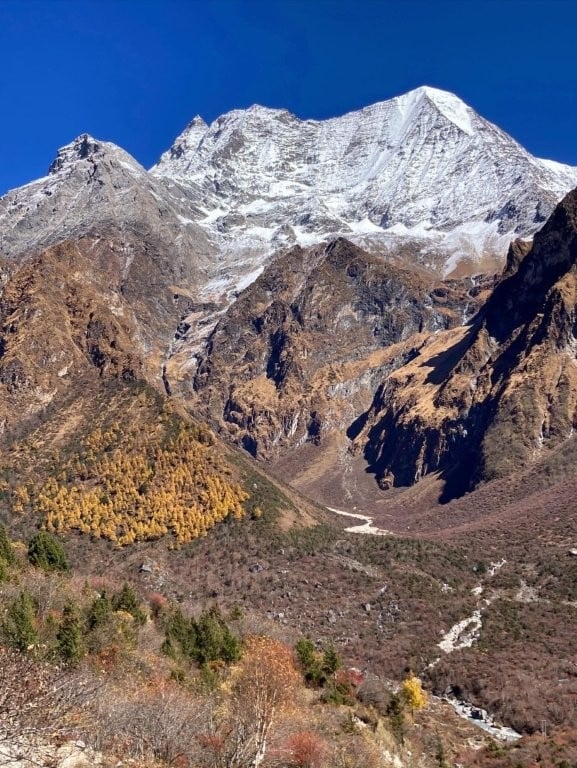
There are lots of larches (or something similar) on this trail, which happened to be turning yellow in late October. You can make it to Lho (3180m) by lunch, where you enjoy your first really spectacular mountains views. Many people stop there for the night. After that it is about 2 hours almost entirely uphill to Shyala.
In Shyala, it is well worth waking up early to see the sunrise. It is always spectacular as the light slowly hits the mountains but throw in a good vantage point of the monastery and you might get a really special photo.

6 Shyala-Pyungen Gompa-Samagaon (3530m)
14km, 5-6 hrs, 750m gain / 700m loss
Some people choose to visit the monastery as a day trip from Samagaon on their “rest day” but we chose to see it on the way up from Shyala. Both options work, just make sure you see it at some point as it was one of the most spectacular spots on the entire Manaslu Circuit. And at over 4,000m it serves as an important acclimatization hike. “Hike high, sleep low”.

After climbing for 2-3 hours you reach a completely flat plateau where you’ll find the monastery. Then heading back down you’ll be almost entirely on stone steps, and there are some really nice views just on the way into Samagaon (usually just called Sama).

7 Birendra Tal or Manaslu Base Camp
It is recommended to spend 2 nights in Sama and tackle an acclimatization hike on your offday. Some people treat it more as a rest day, hanging out at beautiful Birendra Lake, just 100m or so above town.

Others really put in the work, hiking 6-8 hrs return (1000m gain/loss) to Manaslu Base Camp. We chose a middle option, hiking up the MBC trail to an amazing Birendra Lake viewpoint about 2 hours up the trail at 4,000 metres. Then on our way back down we were able to cut across to the lake itself, witness a trekking couple get engaged in front of their grandma (!), then visit the Sama monastery on our way back into town.

8 Samagaon-Samdo (3860m)
9km, 2-3 hrs, 340m gain / 0m loss
This short day basically alternates between gradual inclines and completely flat trails. Even though it doesn’t feel like you’ve accomplished much, you will be sleeping 350m higher than before and since the next stop is another 600m higher yet, it isn’t a good idea to go all the way to Dharmasal all in one day. More nice mountain scenery, although not quite comparable to the previous few days.
There is an acclimatization hike that starts right from the village of Samdo and takes you steeply up over 4,200m, or you can take the lower path like we did, calling it a day at just over 4,100m.

Unfortunately, because of our surprise blizzard, this is the last stage we can describe from personal experience, although I can still give you the gist of the rest.
9 Samdo-Dharmasala (4480m)
6km, 2-3 hrs, 630m gain / 0m loss
Heading up to the staging point for crossing Larke Pass. Nobody likes staying in Dharmasal (basic, uncomfortable, sharing in dorms) but it is, as they say, a necessary evil.
10 Dharmasala-Bimthang (3720m)
16km, 7-9 hrs, 810m gain / 1570m loss
A very long, tough day with a big climb, probably some snow, and a knee-busting descent to Bimthang.
11 Bimthang-Dharapani (1920m)
22 km, 6-8 hrs, 0m gain / 1800m loss
Down, down, down, but with nice Manaslu views most of the way.
12 Jeep back to Kathmandu/Pokhara
Of course, there are plenty of alternatives:
11-Day Manaslu Circuit Itinerary
Hike from Namrung to Sama all in one day and do either the Pyungen Gompa or MBC on your extra day, but not both.
13-Day Manaslu Circuit Itinerary
Add a rest day in Bimthang to hike to Ponkar Lake and back.
Tsum Valley Add-On
The Tsum Valley is reportedly both beautiful and much quieter than the main trail but it will add 5-6 days to your total trekking time.
Annapurna Circuit

Hey, you’re already here, right? If you’re not out of energy and are still ok with the cold nights, after you reach Dharapani you can simply turn the corner and start walking up this famous Nepalese trek. Count on at least 7-10 days to Jomson, although there are plenty of ways to extend this as well.
Manaslu Circuit – Things to Know
Now, on to the hot topics of the day, all the personalized tips and advice you’ll need to plan the perfect Manaslu Circuit trek. Some will seem obvious, some ludicrous, some irrelevant and, hopefully, at least a few brilliant. Well, that might be setting the bar a bit high. Would “useful” feel more realistic? You be the judge.
General
The first few days are at low altitude and for us, in late October, it was VERY hot. Long days. Lots of sweating. You’ll probably want some lighter clothes for those first couple stages.
But it’s very cold as you get closer to the top. So, basically, the opposite of the last tip. You’ll want lots of warm clothes for those long, cold afternoons before the teahouses fire up the fireplace, usually around 5 or 6 pm. Although on wet/snowy days they may get it going earlier to give everyone a better chance of drying all their sopping wet gear.

The Manaslu Circuit is closer to Pokhara than Kathmandu. A couple hours closer to the start and even more to the finish. So if you’re planning to visit Pokhara anyway, keep that in mind.
If you trek during the festival of Tihar you’ll be treated to dogs wearing flower leis in the mountains. And if you’re not trekking during Tihar, then I guess you’ll see dogs wearing flower leis in the city. Very different experiences.
Getting sick while trekking sucks. Trust me, I’ve done it, oh, every single time. Some worse than others, though, and on the Manaslu Circuit it was just some minor stuffiness and I avoided the throat and fever issues that plagued me on previous treks. In fact, most people end up with some version of cough, sniffles or worse so come prepared with all the necessary meds and plenty of tissues. It is easy to find toilet paper that will take the skin off your nose faster than you can say sandpaper but not as easy to find something marginally softer.

On that note, bring plenty of hand sanitizer. It is always a good idea to keep your hands clean, and even more so when being healthy, energetic and far from a toilet are vitally important. Plus, you never know when you might need a bit of cleaning agent because some super-cute – but also very random and moderately filthy – toddler will walk up and suddenly stick his damp little finger right into the spout of your water bottle.
Drink lots of water. That will be easy to do in the early days because you’ll be sweating like a first-time pickleballer and constantly thirsty. But up higher where it’s colder, it’ll be easier to forget to drink enough even though dehydration makes the effects of altitude much worse. Which is also why drinking beer isn’t a great idea up high, although certain days will make it feel very necessary. Just do your best to offset any Barisinghes with double the amount of water. Luckily, you don’t need to carry a lot of water as it is available at every stop along the way, as well as in many streams and waterfalls (just watch for cattle/yaks/mules defecating nearby). We used Aquatabs to treat the tap water and had no problems.
Even if you’re firmly resisting the inevitable world transition to vegetarianism and have a hard time calling a meal a meal if something didn’t die to make it happen, you should probably avoid eating meat anywhere beyond the end of the road (roughly Deng). There are still some cows, yak and chickens above there but a lot of the meat gets hauled in on the back of mules “frozen”, a loose term if ever there was one.

If you’re travelling with a significant other, watch out for the guy driving the jeep with the sticker proclaiming “I am the dude with cool attitude”. He seems to be a real player.
The amount you should tip guides and porters is very subjective, although NOT optional in our opinion, barring catastrophic occurrences that can be entirely laid at their feet. A general guideline, however, is between 500-1000 rupees per day ($US4-7). We also tipped our driver because, man, that drive sucks.

The Manaslu Circuit was very busy while we were on it. Was that unusual or just the start of a new normal? Hard to say, as even the guides and guesthouses seemed surprised by the numbers, but we suspect it has simply turned the corner to become one of the “big treks” of Nepal. Unfortunately, it will probably take a few trekking seasons for capacity to catch up to its new popularity. To deal with this, we recommend giving your guide a list of preferred teahouses, at least one for each planned stop so they can call ahead and reserve a room. There seems to be an unwritten rule that says no reservations until a day or two ahead. But that was still plenty early for us to get a room in each stop, while we did see a few people without reservations forced to continue walking to find a room an hour or two further on.
If/when we return to the Manaslu Circuit, we would deal with this issue by planning to stay in some of the many quieter teahouses that can be found in between the normal stops. There is pretty much a teahouse with rooms every 30-60 minutes all the way along the trail but many of the ones outside villages only get people stopping for tea or lunch. It should be easier to find rooms in these spots, plus it will put you on a different hiking schedule than most, likely giving you a couple peaceful hours on the trail each morning.

Cell data was shockingly good throughout most of the trek. We bought physical Nepal Telecomm (NTC) SIM cards in Kathmandu (10gb / $US9) and we got pretty good LTE connections probably 75% of the time. Better than in some parts of Kathmandu. I also had an NCell eSIM but supposedly it doesn’t work as well in the mountains. I only tried it on those few occasions where my NTC SIM wasn’t working and the NCell never did in those places either, so it definitely wasn’t better. Another person we met had a Namaste SIM and they said it worked pretty well also, but we can’t directly compare.
Almost every guesthouse has wifi, some free and some paid (usually $US4) but it was almost always worse than the cell data, especially once a lot of people were trying to connect. I’d say we found it usable about 25% of the time.
One bit of unqualified good news – every single room we stayed in had its own electrical outlet. Pretty useful when using your phone for everything from photos to maps to flashlight to downloaded Netflix to looking up the most effective squat toilet stance for the flexibility-challenged. Surprisingly, a North American adapter actually fit better than Euro plugs in most of them, although obviously a specific Nepalese adapter is best.
If you’re excited to add a social aspect to your Manaslu Circuit trek, the easiest way is to get really drunk and spend hours grinding with perfect strangers on the dance floor. Unfortunately, those opportunities were in short supply in the mountains, so the next best option is to share a table with someone. Space is always at a premium in the guesthouses and sharing is often necessary. So you might as well be proactive and join up with some people who look likely candidates for a “trekship”, maybe because they seem fun, or they speak the same language as you, or maybe because you just have a lot of questions about that specific style of moustache.

If you are dragging your tired ass into town and are surprised to spot a young guy wearing a full suit and flip flops riding a motorbike, not to worry, you’ll almost certainly see him again when he’s checking your official permits later.
The Manaslu Circuit was interesting from a hiking perspective as almost everyone we saw fit the bill as a “good hiker”. Probably because it is notoriously difficult. And also because it still falls well down the pecking order of treks in Nepal, which means that many of the trekkers had already spent time on Everest, Annapurna or both. And even if it was their first visit to Nepal, it would be truly bizarre if the Manaslu Circuit was their very first long-distance trek anywhere. Something that can NOT be assumed on popular routes such as the Tour du Mont Blanc, Inca Trail or Camino de Santiago.
Of course, by “good hiker” we mean fit, prepared, at least moderately agile. NOT, unfortunately, that they practice good trail etiquette or otherwise exhibit general common sense. Like, for example, letting faster hikers pass on narrow trails. Or stepping to the side when stopping to admire the scenery and/or receive a historical briefing from their guide.

On a related note, we found that most trekkers on the Manaslu Circuit all hiked at a similar speed. There were a few exceptions, of course, including a few eager beavers who flew past us, never to be seen again, and a few following the slow and steady, smell the flowers, take tea whenever it’s offered school of thought, and even one, ahem, jogger (!) but, for the most part everyone moved at the same pace, leapfrogging throughout the day based on the timing of breaks. Which means that, likely, the people you see on the trail first thing in the morning, are going to end up playing a big part in your day. So try to be nice.
Showers were available in every guesthouse. HOT showers, on the other hand, were far less common and typically cost an extra fee ($US2-4). And, like many rarely spotted specialties, often ultimately mythical. I mean, “not completely freezing”, sure, but “hot”? Don’t get your hopes up, is all I’m saying. But if you are determined to stay clean and can handle some short-term pain to get there, you WILL have that option. Even softies like us partook in a few cold dips.
Most toilets along the Manaslu Circuit are of the Asian squat variety. Which makes sense since, you know, Nepal is in Asia. I, however, am NOT Asian. One of the presumably many reasons I am terrible with squat toilets. Number one being a hip flexibility score of approximately 0. Out of 100, I think. Luckily, though, there ARE a few Western toilets to be found. You won’t be able to count on them and good luck figuring out in advance which places have them (Google reviews might give a hint now and then) but they are always a thrilling find.

Speaking of pain, short-term or otherwise, apparently there are leopards in Pokhara. Like, actual leopards. According to a British guy who lived there for a few years and saw his dog attacked by one right in his backyard (yet lived to tell the tale). Well, the dog didn’t tell the tale, obviously, but this guy sure did. I know what you’re thinking but, yes, I do believe the story was legit.
Much of the Manaslu Circuit is located in a fertile apple region. So if you get a chance to pick up some apples or, even better, some classic local apple juice, definitely do. There is a great booth just shy of Namrung that clearly specializes in fresh apple juice. And, just as clearly, they do NOT specialize in baking brownies. Consider yourself warned.
If you’re not on a full tour but are paying for your rooms as you go, the price is the price. They aren’t interested in bargaining, nor should they be, considering the already ridiculously low prices of the rooms. However, if you do happen to find yourself in a sticky situation where only very overpriced deluxe rooms are left, despite your previous reservation, your guide may be able to work out a better deal that meets somewhere in the middle. And results in your very own attached hot shower – possibly the highlight of our entire trek.
Like in every affordable trekking destination in the world, expect to encounter a large number of young Israelis. Always in groups of 4 or more, either talking excitedly or fully focused on rolling their own cigarettes.

Laynni started hiking in compression leggings a few years back and says they make a huge difference for her legs, and knees, in particular. And, it turns out, they remain surprisingly effective even when worn backwards, something Laynni figured out about 6 hours or so into one of our toughest hiking days. They definitely look weirder that way, though.
The teahouse kitchens are organized chaos. Except for the “organized” part, I was just being nice with that one. Never, under any circumstances, set foot inside one. It’s bad enough when the local staff are joined by a dozen guides, they don’t need you, too. They are like Nepalese versions of The Bear, and you’re Uncle Jimmy. Don’t be Uncle Jimmy. Well, except for the money and funny insults parts, those are fine. Just don’t drop in unannounced, I guess.
Which is probably a big reason why guides are mandatory on the Manaslu Circuit, so that nobody in the guesthouses every has to deal with us tourists. I mean, there is always at least one person around that speaks some (often a lot of) English and you can ask for simple stuff but, for the most part, it just makes their life so much easier having the guides as intermediaries and not having us constantly bothering them for things in their third or fourth language. Kind of how I feel when our nephew tries to tell us a story about dragons.
Most people get up early, hike hard all day, have nothing much to do at night, so end up in bed very early. It’s generally quiet, is what I’m saying. So that’s nice. Still, ear plugs are a good idea. The walls are VERY thin, a large number of men snore like they’re practicing for a big sleep apnea competition and, just when you think you’ve found the ultimate half-empty, completely quiet guesthouse, there’s always a non-zero chance a herd of mules will take up residence under your window and spend the night snorting, braying and farting. Not necessarily worse than a room full of exhausted Germans, just different.
A lot of the shared guesthouse bathrooms have windows looking in on them. Which is cool, I suppose, if you find it way easier to pee when strangers are watching. If that’s not your thing? Well, be quick I guess.
Art isn’t a key component of most Manaslu Circuit teahouses. But keep an eye out for the impressive sketch of Tommy Shelby in Peaky Blinders. Why? Because it’s super random, that’s why.
Even if you’re not actually tall in the real world, you might still be kind of tall in Nepal, so maybe try to be extra careful about not hitting your head on things. Things like door frames, showerheads and, very specifically, metal beams in the back of jeeps, over and over. Is what I wish someone had reminded me. Luckily the scabs were almost gone after a few days out of the mountains. At least they were until the young barber got digging in there with his weirdly huge comb. Back to square one, scab-wise.

There are many, many roosters to be found along the Manaslu Circuit. Not all roosters, however, are equally sexy. Which was the key conclusion reached during 3 solid hours of aimless conversation crammed into the back of a bouncing jeep on the final leg of our desperate escape. Time well spent, clearly.
Travelling Between Pokhara and Kathmandu
There are a number of flights each day that are very short (half-hour) and cost around $US100 one-way. However, flights in Nepal are often delayed and while this is still the fastest option, don’t discount the hours spent getting there early to checkin and the occasionally long wait for your bags to come out after.
Buses between the two main tourist centres in Nepal have come a long way in recent years. They now have something called a “Luxury Sofa Buses” which feature literal sofa chairs – like you might find in the house of a grandparent or university student who scrounged all their furniture out of their parents’ basement – deployed in a 2 and 1 formation, leaving plenty of room for everyone. The ones we booked through Rainbow Adventure Travel were actually quite comfortable and cost roughly $US10. The downside, the 200km trip takes anywhere from 7-10 hours, including 3 breaks (2 bathroom, 1 lunch).

We recommend asking for seats on the north side of the bus as the views are much better and you won’t have the sun shining directly on your window (although there are curtains). This will usually be the set of 2 on the way to Pokhara and the singles on the way to Kathmandu.
Where to Stay in Pokhara
We much prefer Pokhara to the chaos of Kathmandu but it all depends on what you plan to do before and after the trek.

Hotel Adam is right in the thick of it but if you get a room toward the back it can still be quiet. Plus, they have a great breakfast, amazing views from the comfortable rooftop, including a refreshing pool
Hotel Lake Shore is a comfortable hotel with breakfast and some rooms with excellent lake views. It has a very handy location for the bus station and for getting to and from the eastern trailheads.
Hotel Dashain offers 4-star comfort in a quiet spot a few blocks in from the business of the lakeshore. A good choice to recuperate after a long, difficult trek in the mountains.
Where to Stay in Kathmandu
Nivas Boutique Hotel is an excellent value choice with friendly owners, great staff and outstanding city and mountain views from the comfortable rooftop. Breakfast is great as well. The unique thing is the location, a few blocks outside Thamel. The walk in and out can be tiresome but we really enjoyed the very quiet and authentic neighbourhood.

Divine Kathmandu has a great location in Thamel – but not on the busiest street – and features a fantastic pool with views on the roof. The rooms are modern and comfortable and it is great value for what you get.
Lemon Tree is a beautiful 5-star hotel but at midrange prices. With all the amenities you’d expect from a high level hotel, including terrific views, it is the perfect place to recover from the cold discomfort of the high mountains. The catch is that it is outside Kathmandu itself so you may feel a bit isolated, but if you just want to relax and soak in the comforts, this is a great choice.
Manaslu Circuit Packing List
There are quite a few things that are basically assumed when trekking in the Nepalese Himalaya. Good hiking shoes and socks, proper rain gear, warm clothes for night. We had a lot of this stuff with us but did opt to rent a few things we didn’t want to carry for the rest of our trip. Sleeping bags, micro-spikes, gaiters and another warm jacket for Laynni and an extra water bottle/thermos.

However, here are a few less obvious things to think about as well.
Sleeping bags – technically, every guesthouse offered blankets, although as we went up higher and it got colder we found our rented sleeping bags ($1/day) to be much warmer and sometimes even combined the two. However, if you are carrying your own gear and tend to sleep warm, you could probably get away with relying on their blankets.
Hut shoes/flip flops (I specifically carry slides so I can wear socks in them).
Merino wool hiking socks (2) – I love switching to dry socks throughout the day.
An entire outfit for sleeping/lounging/eating/basically anything but hiking.
Laynni wears compression leggings and I carry small knee supports to wear on the particularly difficult downhill sections. Of which there are many on the Manaslu Circuit.
I always carry 2 pair of quick-dry underwear that can be washed easily (in the shower is my routine) and Laynni brings a wool bra to hike in so she doesn’t cool down as much on breaks, plus a second bra that remains dry and comfortable to sleep in.
Merino wool long-sleeved shirts – 2 for hiking and one for the hut.
Jackets – 1 fleece / 1 windbreaker / 1 puffy jacket.
Rain poncho/pants/gaiters/gloves – some prefer a regular jacket and backpack cover but we find ponchos, while not necessarily stylish, keep everything fully dry, unlike the other method.
Hiking poles – if you’re ever going to use them, this is the place. I also carried rubber tips that came in handy on the days with a lot of stone steps.
Micro-spikes – Very important when navigating steep slopes in the snow (or even mud). You can hope you don’t need them, but if you do you’ll be very happy you have them.
Gaiters – I had a small pair with me but Laynni rented a set just for the trek. In good weather, not so necessary but they really came in handy in the snow and mud.
We carried TWO power banks in anticipation of limited charging spots. And we ended up with a private outlet in every single room. So it’s still worth having one as a backup to use during the day or if there is a power outage, but it’s not the big concern it used to be.
Aquatabs – these are the cheapest, lightest and easiest way to treat water, avoiding plastic bottles.
Ear plugs – the walls are THIN and there is always somebody up at 5 am for some reason.
Pack towel – it was possible to have a shower in every place we stayed. It was only possible to have a HOT shower in a couple of them, though. Pick your poison.
Head lamp – for the best chance of good weather, most people start up to Larke Pass in the dark well before sunrise.
Snacks – unless you really love rice, noodles and curry, you are probably going to have some cravings before the trek is all said and done. We always carry nuts and Snickers for protein and energy, along with a few weird specialties Laynni prefers not to live without:
Summary
The Manaslu Circuit definitely qualifies as another impressive Himalayan trek. Is it “the most beautiful trek in Nepal”? Not in our opinion, bearing in mind the fairly large caveat that we didn’t get a chance to experience the supposedly incredible view at the pass. Either way, though, the early days are very long and difficult and, while the valley scenery is quite pretty, you definitely don’t get the epic alpine views of Everest or Annapurna Base Camp. Those come, of course, it just takes more time and effort to reach them.
Bottom line, the Manaslu Circuit is absolutely a gorgeous mountain trek and good value for the challenge. Weather permitting, you will enjoy tremendous scenery, teahouse camaraderie and make memories that will last a lifetime. But if we had to choose just one hike in Nepal, it would still be to the Gokyo Lakes in the Everest Region, or up to Annapurna Base Camp and back if you are short on time. Feel free to disagree, though, since you can’t go wrong with any of them!
Pin it for Later!

Other Posts You Might Like:
Gokyo Lakes Trek: A Spectacular Everest Base Camp Alternative
The Best and Worst of the Annapurna Circuit
The Annapurna Base Camp Morning Show!
Tour du Mont Blanc or Everest Base Camp?
Ala Kul Trek: A Classic Kyrgyzstan Mountain Hike
About the Author
Dean Johnston

Dean Johnston quit his job as a financial planner in 2008 to travel the world, and has now visited all 7 continents and more than 90 different countries. He wrote his first blog entry in a sweltering internet cafe in Bali in 2000 and has been writing about their travels ever since, including publishing 3 travel books.
As Routinely Nomadic, Dean remains focused on providing informative travel guides, entertaining stories and useful social media content to readers from all over the world.