

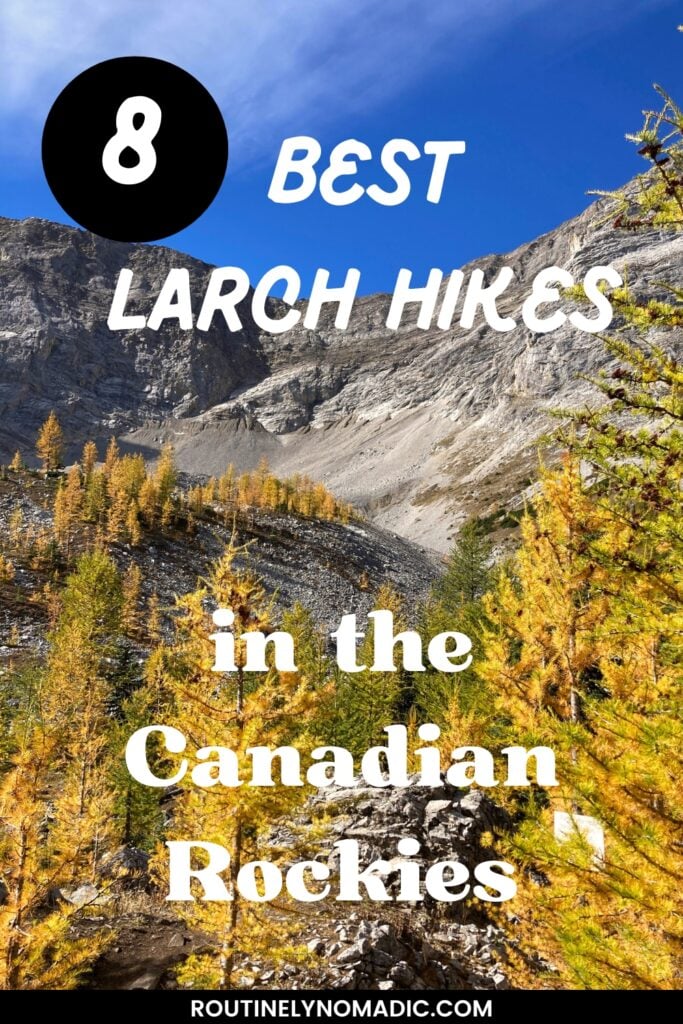
Larch season is becoming one of the most popular times to visit the Canadian Rockies, much like fall foliage in eastern Canada. Larch season is when the lovely larch trees start changing colour from their usual dark green to a brilliant yellow hue that lights up the slopes, providing spectacular landscapes and fabulous photos. So, not surprisingly, we have spent quite a bit of time over the past few years seeking out all the very best larch hikes around Banff, Canmore and Kananaskis.
Until a few years ago we had never heard of larches. Or if we had, we didn’t know what they were and didn’t care to find out. Then we found ourselves spending a month in Canmore one fall and, boy oh boy, we quickly found out what they were. And we couldn’t get enough.
Our site includes affiliate links to products we recommend. If you use one to make a purchase, we earn a small commission at no extra cost to you. Thanks for your support!
There are lots of different places to see larches in the Rockies around Banff, Canmore and Kananaskis but, rather confusingly, they don’t seem to follow any particular pattern so it is important to do your research before heading out. Wandering around aimlessly on the lookout for yellow won’t get you very far, especially since most of the larches are found well above the roads and involve some hiking to reach.
And we’ll get to all that. But, first, to answer a few of your burning larch questions:
What is a larch? Is it the same as a tamarack?

When we told people in Saskatchewan about larches they usually asked “oh, like a tamarack?”. A valid question. But, not, they are not quite the same. Apparently they are the same genus, the larix, but a different species. For most people, though, close enough.
And, although the larch needles look similar to those found on pines or firs, the needles are actually quite soft. So there’s that.
Where do larch trees grow?
Larches can be found in many areas of Northern Europe and Asia as well as, and this is the important for us, in northern parts of North America. Specifically, Canada!
Larches tend to grow in cold climates and mountainous areas and need a lot of moisture so the Canadian Rockies are perfect for them. They also tend to grow especially well in areas where there have been recent forest fires, something we unfortunately have plenty of these days.
Why do larches turn yellow?
Larches turn yellow in the fall because they are saving nutrients to use later. As winter approaches, the weather gets colder and the days shorter, the chemical machinery of the larch needles that lets them photosynthesize now breaks down and these chemicals are then stored elsewhere in the tree.
This leads to the needles turning yellow and, eventually, falling off, just like leaves. One benefit of losing the needles is that during heavy snowfall larch branches are less likely to break.

When is larch season?
The larch season in the Canadian Rockies tends to start the second or third week of September. It all depends on weather. Once the needles start to change there is about a 2-week window before they complete their transformation and eventually the ground is covered in a carpet of dark gold needles.
How do you know when the larches are changing?
The most timely way to monitor the stages of the larch trees is by following the hiking reviews on AllTrails. Because the app is so popular in this area, the more popular hikes generally have new reviews and photos posted every day.
The larches seem to change at slightly different times in different areas. Obviously the weather affects them, but it seems that even minor elevation changes also make a difference, with higher ones usually changing first.
Our other observation is that the older larches changed colour and dropped their needles first while the younger larches retained their needles longer.

What is the best way to plan larch season?
It isn’t easy to plan larch season ahead of time, since the exact dates change every year. If you happen to live nearby you can be flexible and wait for just the right moment. But if, like us, you live farther from the mountains, you’ll probably need to pick the most likely timeline and then just hope for the best. One year we spent an entire month in Canmore from mid-September to mid-October so were around for the entire process. Other years, however, we have simply planned a trip for the last week or so of September and it has typically worked out.
In general, they start changing around Sep 15 and you can probably still find them until Oct 7 or so. Give or take a week in either direction. For the best odds, Sep 20-30 should give you a great chance to find them somewhere, especially since the larches change at different times on different trails.

Where are the best larch trees near Canmore?
Larches can be found all over in the Canadian Rockies. The larches are especially plentiful in Kananaskis Country around Canmore, but you can also find many great larch areas in Banff National Park and Yoho National Park (just over the border in British Columbia). However, it can be hard to find wide swaths of them and almost all the best spots require you to hike in (they tend to be at higher elevations than the roads). So it is important to have a plan to maximize your time during season.
Obviously, there are many more larch hikes in the area and we haven’t had the opportunity to try them all (yet!) but we’ve seen our fair share and, so far, these are our favourites.
Map of Best Larch Hikes Near Kananaskis
Click the star to save this map to your Google Maps – then find it under Saved/Maps (mobile) or Your Places/Maps (desktop)
The Best Larch Hikes in Kananaskis
In our opinion, Kananaskis is the best hiking area in the Canadian Rockies. Somehow it is just now starting to gain international recognition, so expect to hear a lot more about it in the coming years.
Kananaskis Conservation Pass
Every vehicle parking at trailheads in Kananaskis Country or the Bow Valley Corridor needs to purchase a Kananaskis Conservation Pass (with a few specific exceptions). The passes cost $15/day per vehicle or you can get an annual pass for $90 that covers 2 vehicles. Of course, this only covers the hikes in Kananaskis – for the hikes the national parks you will need to purchase a Parks Canada pass.
The hikes are listed in no particular order and we have provided the AllTrails link so you can easily check the details and read the most recent reviews. All of these Kananaskis larch hikes have amazing scenery, although they all require some uphill hiking to reach the best parts.
Ptarmigan Cirque
4km / 1.5 hrs / 270 m gain
https://www.alltrails.com/trail/canada/alberta/ptarmigan-cirque

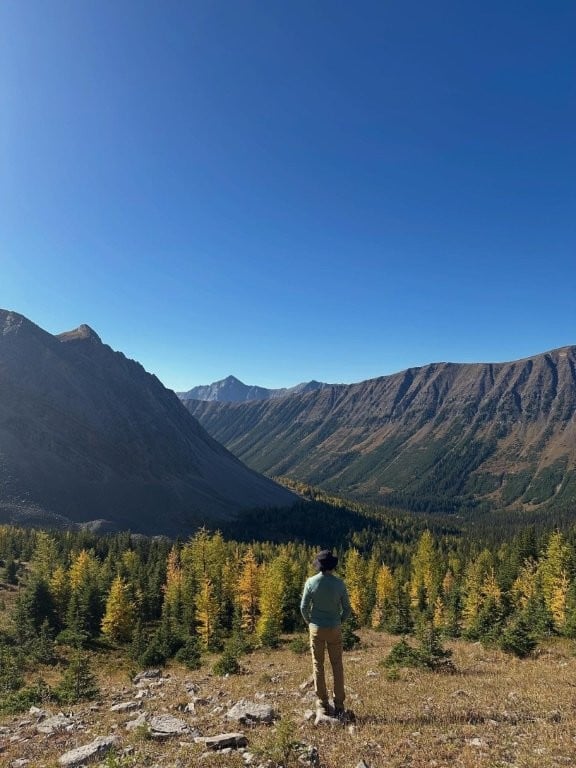
This was our very first Kananaskis Country larch hike. It is around an hour’s drive from Canmore along the insanely beautiful Highway 40. For whatever reason, the larches seem to change a little earlier on Ptarmigan than some nearby hikes, even though they seem to be at the same elevation.
It is probably the easiest Canmore larch hike, so it tends to get very busy and you’ll probably see a wide range of hikers from speedsters to families with toddlers. And, yes, it is quite short and relatively easy but don’t underestimate the climb as it is fairly steep. However, once you get above the tree line you reach a lush, larch-filled valley nestled beneath impressive looming peaks. There is a small waterfall at the end of the valley and awesome views in every direction.
Arethusa Cirque
4.5 km / 2 hrs / 380m gain
https://www.alltrails.com/trail/canada/alberta/arethusa-cirque-route
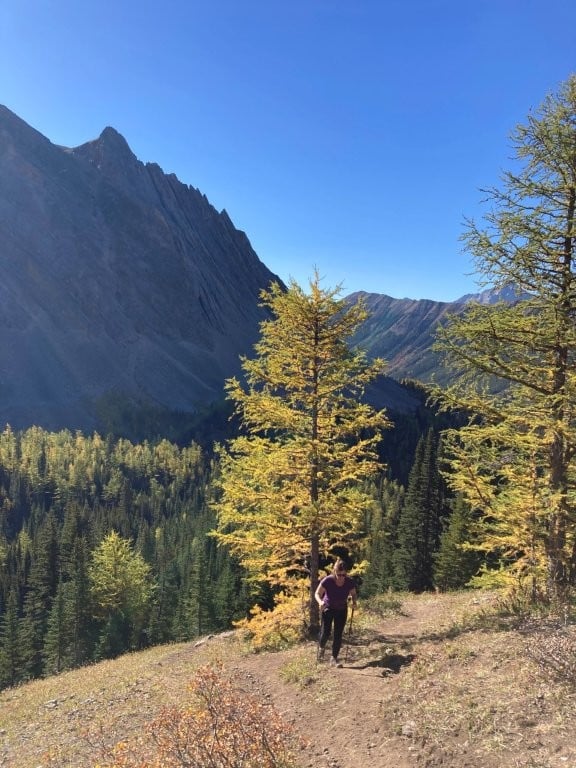
In the same area as Ptarmigan Cirque, it is a similar trail in that you start hiking up through the trees and a loop around the cirque at the end. However, Arethusa is a little tougher because the trail is not well-maintained, there are a couple very steep parts and you have to cross a boulder field at one point. However, it is still less than 5 km in total so it represents another short larch hike option.
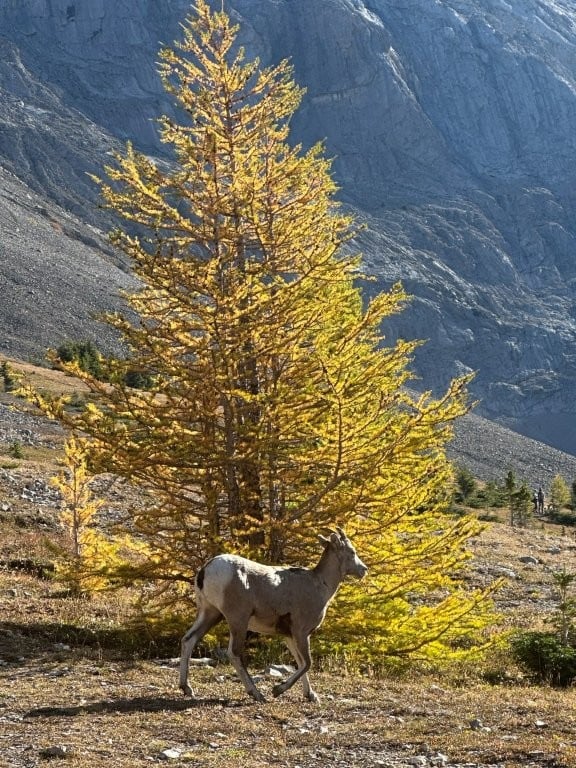
It’s a good idea to do the trail clockwise so that you go up the steepest parts of the trail. It’s a fairly quick hike for the great mountain and larch views you get. Keep an eye out for the fossils in the rocks and the resident herd of mountain sheep that often hang out in the meadow near the top.
Chester Lake
10km / 2.5 hrs / 400m
(probably 1-2 km shorter if you stop at closest point on lake)
https://www.alltrails.com/trail/canada/alberta/chester-lake-trail

Also found in Kananaskis Country but farther west on the gravel Smith-Dorrien Trail south of Canmore, this is another very popular larch hike. Of course, we knew that, so there is really no excuse for choosing do to it on a Saturday morning. But we did and, yep, it was very busy. At times it felt we were sharing the trail with half of Calgary.
Still, it’s a beautiful, easy larch hike that follows a wide, gradually sloped trail with plenty of room for everyone. For us, this was also a perfect example of needing to be prepared for any kind of weather when hiking in the mountains. The day we visited, it was bright and sunny in Canmore and snowing heavily at Chester Lake. Which is why we follow our day hike packing list and always have layers, gloves and toques even when don’t think we need them. Unlike the girl hiking up in short-shorts, shivering with her legs pink with cold.
Anyway, once you have navigated the relatively gentle 400 meters of elevation gain, the trail opens up to a series of meadows and ends at Chester Lake with mountains edged right up against it. Larches surround one side of Chester Lake and you can hike all the way around for reflection photo opportunities.
Now, in a hiking sense, the snow wasn’t ideal. The mud and all. But from an aesthetic point of view, it was pretty cool because it introduced us to our very first “snarch”. Snow larch. Get it? Yeah, we’re clever that way.
Another benefit to visiting Chester Lake is for the drive itself. Because even though the Smith Dorrien Trail is a gravel, quite rough and often dusty, it is also incredibly scenic and even made our list of the best things to do in Canmore.

Plus, Chester Lake, Arethusa Cirque and Ptarmigan Cirque all made our list of the best easy hikes near Canmore.
Pocaterra Ridge
10 km / 5 hrs / 700m gain / 1000m loss (all the way to Little Highwood parking lot)
5 km / 2 hrs / 120m (stopping at the larch meadow)
https://www.alltrails.com/trail/canada/alberta/pocaterra-ridge

A challenging but fantastic hike that also makes our list of Best Hikes Near Canmore, Pocaterra Ridge also features some amazing stands of larch trees. However, the difficulty and the fact it is best done as a point to point hike with 2 vehicles mean it doesn’t work for everyone. Luckily, though, even if you aren’t up for an exhausting (but epic) 5-hour hike up, over and along a sometimes sketchy ridge, the best section of larches can actually be reached with far less effort.
It takes only an hour to reach the best larch area in a lush valley below the ridge itself (and surrounded by other peaks). So if you are more interested in the beautiful larches and less in the panoramic views found at the top, you can shorten it to a lovely, relaxed 2-hour stroll.
The Pocaterra Ridge trail starts from the same large parking lot as Ptarmigan Cirque but the trail isn’t nearly as busy, another benefit of heading that way.
Honourable Mention
Tent Ridge Horseshoe
10 km / 4-5 hrs / 850m
https://www.alltrails.com/trail/canada/alberta/tent-ridge-horseshoe
The truly spectacular Tent Ridge hike is one of our favourites but its larches surprised us, as it isn’t really know for them. Since the vast majority of the hike is spent far above the treeline, the bright larches generally seem secondary to the surrounding scenery. However, there are a few larches at the beginning and some pretty good sets near the end, so it deserves a mention. Although, keep in mind, this is a very difficult hike with exposed areas and some scrambling.

Check out our guide to hiking the Tent Ridge Horseshoe Hike.
Rummel Lake
11 km / 3 hrs / 450m
https://www.alltrails.com/trail/canada/alberta/rummel-lake-trail

This is a much easier alternative to Tent Ridge that starts just across the road. In fact, one of the best things about hiking to Rummel Lake are the great views across to Tent Ridge. That view, however, is short-lived as most of the trail is spent deep in the trees without much for views.
The lake itself is pretty, though, with steep cliffs on two sides and some decent larch forests on the other two. Keep in mind, the sun takes awhile to make it over the mountains and the lake won’t be lit up until at least noon (a bit earlier in summer).
NOT Larch Island
Larch Island is just a short walk from downtown Canmore and obviously the name sounded pretty promising. Unfortunately, there are NO larches on Larch Island. Misleading…
The Best Larch Hikes in Banff National Park
Lake Agnes
7.5 km / 2.5 hrs / 430m
https://www.alltrails.com/trail/canada/alberta/lake-agnes-trail

This trail is in Banff National Park and starts at the startlingly blue Lake Louise. The hike up to Lake Agnes and its popular tea house is worth it all on its own for the views of Big Beehive and Devil’s Thumb. There are also many reflections, the main reason this lake made it onto our list of best photo spots near Canmore.
Lake Agnes is always beautiful, but in the fall you add in the fact that it is surrounded by larches, taking this hike to another level. Strangely, not many people mention Lake Agnes on their list of best larch hikes so we were quite surprised to find so many.
Make sure to walk around the lake to get up close to the larches and for the view back to the teahouse (and if you have the energy, continue on to the Big Beehive viewpoint over Lake Louise).
Larch Valley Trail from Moraine Lake
7.5 km / 3 hrs / 430m
https://www.alltrails.com/trail/canada/alberta/sentinel-pass-trail

This is the most famous and often considered the best larch hike near Banff. Which makes sense, you know, since it actually has larch right in the name. It is also popular for the sheer number of larches and the surrounding epic scenery. It’s another trail that involves about an hour or so of hiking up a fairly gradual path gaining over 400 meters in elevation.
Once up to the valley though, you are surrounded by golden larches. And it gets even better as you continue along the valley, eventually looking back down at the huge, yellow expanse of forest. At which point you may think, hey, those 10 mountains in the distance look kind of familiar. And they should because they perfectly match up with the image on the Canadian $20 bill. Now, obviously, cash isn’t quite king any more but if you can somehow manage to track a bill down, be sure to take it with you on your Larch Valley hike.
A longer option of the trail continues up to Sentinel Pass, providing an even more spectacular view over the entire area. This longer version, though harder, made our list of the best hikes near Canmore.
You can no longer drive to Moiraine Lake so it is important to book a shuttle from Lake Louise. Reservations can be made 48 hours in advance.

Eohippus Lake
25km / 8 hrs / 850m gain
22 km / 7 hrs / 650m from Sunshine Meadows if the gondola is running
https://www.alltrails.com/trail/canada/alberta/eohippus-lake

Most of the larch hikes we went on were very busy. Because, you know, larch season and all. Since it only lasts two weeks there are a lot of people out larch hunting. But we were lucky enough to be introduced to this hidden gem larch hike by friends who live in Calgary and hike the area frequently.
This trail starts out along the same route as the hike to Healy Pass (also a popular larch hike) but is much quieter. In fact, once we we turned off the Healy Pass trail to head towards Eohippus Lake we had the trail all to ourselves. If the Sunshine Gondola is still running you can shorten it somewhat, although, for some inexplicable reason, the gondola usually shuts down for the fall right around the start of larch season. If you can’t use this shortcut, you’ll start with a pleasant and shaded but rather dull 6 km of uphill walking from the Sunshine parking lot.
But then the larches start. They told us to not to get too excited as it would keep getting better. And they were right. We passed multiple lakes and meadows surrounded by larches in their bright golden yellow prime glowing in the sun. Quite stunning in places.
Hiking all the way to Eohippus Lake – with or without the gondola – makes for a long day but if you’re looking to escape the Banff larch season crowds this is a terrific option.

The Best Larch Hike in Yoho National Park
Yoho National Park is just over the border in British Columbia and features some of the most incredible scenery in the area. There are many good hikes in the park but for larches, one choice stands alone.
Lake O’Hara Alpine Circuit
11-13 km / 5-7 hrs / 800m
https://www.alltrails.com/trail/canada/british-columbia/lake-ohara-alpine-circuit

Not only is this a fantastic larch hike in the fall, it is also one of the very best day hikes in the world. Yep, you heard that right. And we don’t throw that kind of compliment around lightly. But Lake O’Hara is a pretty special place.
One of the reasons it is so beautiful and pristine is that it is highly regulated. Which, for most people, means you either need to queue up for a campsite the day reservations open in January or join the random bus draw in April. Both will require some luck.
Or there are two other options that are less popular for very different reasons. One, you can shell out some big bucks for a cabin at the lodge. Two, you can hike in, which adds 11km just to reach the lake. Then you start hiking the trail from there. Not easy but during our latest visit we saw at least 20 people trudging up the road. So it IS possible. And, before you ask, no, bikes are not allowed.
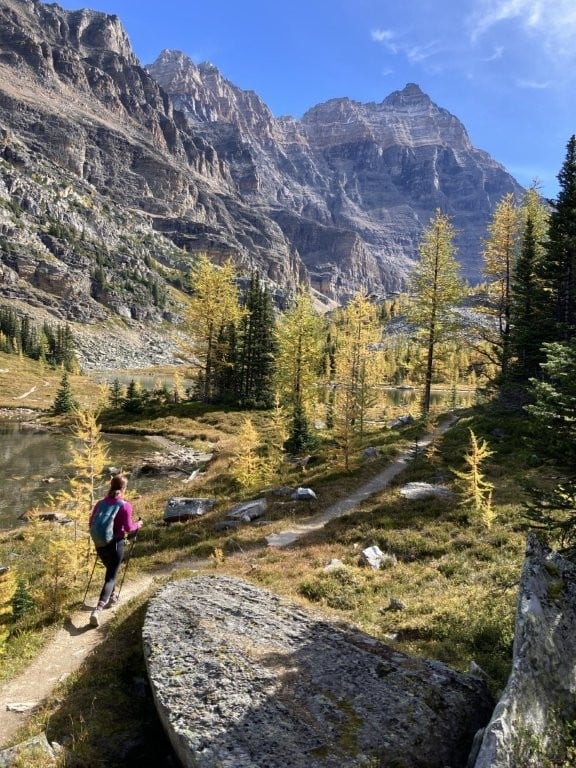
No matter how you choose to visit, make sure you try to get to Lake O’Hara at some point, it is certainly worth it. And there a plenty of shorter variations in case you aren’t up for tackling the entire circuit. For everything you need to know to plan your bucket list visit, check out our Complete Guide to Lake O’Hara.
Where to Stay in Canmore
A benefit of slow travel and staying for a month is that we can also rent a fully-equipped apartment, get a monthly rate and have plenty of space and all the comforts of home. We have occasionally camped at the Bow River Campground, a decent option with good bathrooms, average showers and a good location next to the river (but a fair bit of highway noise, as well).
If you’re looking for more comfort, though, we also spent a full month at Canadian Rockies Chalets and it was excellent – well-equipped, roomy and walking distance to grocery stores and downtown.
A couple other good choices in Canmore are Base Camp Chalets (next door) and the Lamphouse Inn, which is right downtown.
Trip Planning Resources
Here is a list of the most important resources we use when planning our travels, all in one convenient spot. Full disclosure, when you use any of these links to reserve or sign up for something, we receive a small commission which is greatly appreciated. However, your price does not change and we have only included products and websites that we can honestly recommend.
- We book the majority of our hotels on Booking.com. With frequent stay discounts, thousands of reviews and free cancellation, it is very rare for us to have a bad hotel experience these days.
- Wise is by far the best international multicurrency bank account we’ve found. We can now send and receive money in half a dozen different currencies, convert to dozens more with no exchange premium and pay or withdraw local currencies. Highly recommended.
- When travelling we always get SIM cards with data for our phones. Local SIM cards are sometimes a bit cheaper but if you have a relatively new smartphone (iPhone XR or newer, Samsung S20 or newer) you can just buy an eSIM online, get a QR code by email and you’re good to go. After extensive research we have found that Nomad eSIMs usually have the best coverage and prices.
- Google is currently transitioning to an AI-only model and are now actively suppressing private websites. In most cases, they don’t even share attribution links to show where they got their information. Legal theft, apparently, which is terrible for travel blogs, as well as people who actually use travel blogs for trip research (i.e. us) rather than just hoping the latest AI mashup is somewhat accurate. Anyway, the point is, if you still want to read firsthand travel information, we recommend using DuckDuckGo as your search engine. You might even find some delightful Routinely Nomadic posts ranking high in those results.
- If you’re interested in local guided tours, including everything from city tours to cooking lessons to adventure activities, check out the huge range of options at Get Your Guide.
Summary
Larch season in the Canadian Rockies is truly a bucket list experience. If you are into hiking and scenery and prefer hiking in the cooler weather of fall anyway, then these terrific larch hikes around Canmore and Banff are ideal.
Pin it for Later!
Other Articles from the Canmore Area:
Johnston Canyon Hike: How to Visit in 2021 with the Road Closure
Wasootch Ridge Hike: A Classic Kananaskis Hike
Lake O’Hara: Your Complete Hiking and Camping Guide
Floe Lake – Numa Creek Loop: An Epic Backcountry Adventure
Mount Kidd RV Park: A Visitor’s Guide
Elbow Lake and Rae Glacier Hike
Berg Lake: A Spectacular Rockies Adventure
7 Amazing Drumheller Hiking Trails
The Best and Worst of Drumheller Camping
Drumheller: The Ultimate Guide to Alberta’s Dinosaur Capital
About the Author
Dean Johnston

Dean Johnston quit his job as a financial planner in 2008 to travel the world, and has now visited all 7 continents and more than 90 different countries. He wrote his first blog entry in a sweltering internet cafe in Bali in 2000 and has been writing about their travels ever since, including publishing 3 travel books.
As Routinely Nomadic, Dean remains focused on providing informative travel guides, entertaining stories and useful social media content to readers from all over the world.