
Gorgeous Berg Lake, in Mount Robson Provincial Park, is one of those near-mythical places found deep in the Canadian Rockies that offers incredible views and serene backcountry vibes to those determined enough to make it there. Because, as beautiful as it is, there aren’t any roads to Berg Lake. Not to mention, no parking lots, restaurants or showers. But it does have incredible Mount Robson looming over it, the highest peak in the Canadian Rockies at 3,954m. Which is, objectively, pretty high.
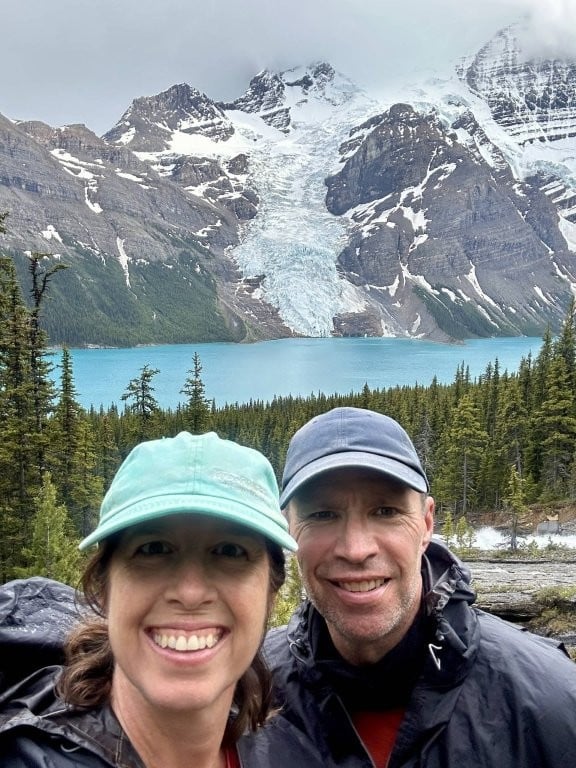
The closest facilities to Berg Lake are a rough 20 kilometres back down the mountain at Mount Robson Provincial Park Welcome Centre. This is where your backcountry trekking adventure will start, receiving a camping permit and some information about backcountry camping and bear safety. Previously, you were also required to watch a seriously dated informational video. Not realizing that “the projector isn’t working any more”, we watched it in advance on YouTube. Needless to say, that’s 25 minutes we’ll never get back, although it was a handy refresher about camping etiquette, all things bear-related and, of course, some of the more disastrous clothing trends of the 90’s.
Our site includes affiliate links to products we recommend. If you use one to make a purchase, we earn a small commission at no extra cost to you. Thanks for your support!
Berg Lake is a popular place, making it difficult to score campsite reservations, but the whole area is simply spectacular and the hike passes through surprisingly varied terrain so it’s well worth making the effort. As far as top backcountry destinations in the Rockies go, we’d say it is fairly comparable to one of our other favourites, Floe Lake on the Rockwall Trail in Kootenay National Park, and probably just one level below the unbelievable Lake O’Hara in Yoho National Park.
Berg Lake Trek
40 km return / 13-16 hrs / 1,100m elevation gain/loss
Those figures are only for the main trail from the trailhead to Berg Lake Campground and back. Side trails to the viewpoint, Hargreaves Lake, Mumm Basin or Snowbird Pass will obviously add more. Emperor Falls is just 5-10 min off the main trail and well worth the side trip.
GPS Map: AllTrails

Mount Robson Provincial Park Backcountry Camping
All of the Mount Robson backcountry campgrounds are in high demand (especially Berg Lake) and reservations must be made through BC Provincial Parks. You usually need to reserve the first day bookings open. For 2026, bookings went online in December 2025 so keep an eye on their BC Parks page for next year’s dates. They also have a notification system so you can sign up to find out when a site becomes available.
We would also recommend joining the Berg Lake Trail Facebook group. There are always interesting trail updates and sometimes people will give a heads up when they are planning to cancel a reservation.
You are required to check in at the Welcome Centre before heading out on the trail where they will review some backcountry information and give you a permit that is meant to be attached to your tent. This will be your last shot for cell service, wifi, electrical outlets and running water.
All Mount Robson backcountry campgrounds have tent pads, toilets, bear lockers and picnic tables. Some also have covered shelters. You have to set up your tent in designated 3m x 3m tent pads with a maximum of 2 tents and 6 people per site. And you can only reserve a maximum of 2 tent pads per campground per reservation.

No open fires at any time. You must use a portable cook stove.
There is no potable water provided along the trail. All water must be treated, boiled or filtered.
All campgrounds have basic pit toilets.
All food and anything else with an odour (i.e. toothpaste, bug spray) should be kept in the bear lockers and take care to never eat near the tents. Backpacks are not allowed in the bear lockers.
Dogs are allowed on the trail for day hikes only and must be kept on a leash the entire time. They are not allowed in the campgrounds overnight and are never allowed on Snowbird Pass to avoid disturbing the wildlife.
Drones are also prohibited in the park unless you apply for a special use permit.
You might get a weak cell signal near the start of the trail but nothing up higher and it is best not to count on it either way. We recommend downloading maps for offline use.
There is no electricity in the shelters so if you need to charge phones or cameras be sure to bring a power bank.
Berg Lake Trail Map
Berg Lake Itineraries
With so many campgrounds to choose from, and the vast differences in hiking abilities, there are almost endless variations for seeing Berg Lake. However, we’ll focus on the most common and, in our opinion, most logical options. Keeping in mind, of course, that campsite availability will probably be the main determining factor.
Intense hikers can make it all the way to Berg Lake in a single day. It will be exhausting, sure, especially carrying a heavy backpack, but certainly possible. Count on at least 7-8 hours. And doing it that way will either allow you to enjoy a very quick trip or give you more time to spend at the lake enjoying the views and multiple day hikes.

The most common schedule, though, involves breaking the initial climb to the lake into two days by spending a night at either Kinney Lake or Whitehorn. Both are nice campgrounds and you might want to let your welcome centre arrival time decide whether to go as far as Whitehorn or just enjoy a leisurely first day to Kinney Lake.
From either of those, Berg Lake is easily reachable by early afternoon the next day, leaving you the option of another day hike (we hiked up to the viewpoint later that day) or a relaxing afternoon.
Coming back down, if you’ve managed to make it all the way up in a day while carrying all your food, then getting back down in a single day (after eating a lot of your pack’s weight) will feel like child’s play. And even average hikers can plan to get out in a single day in around 6-7 hours so, unless you’re planning a day hike that same morning, there is no real need to break it up on the way down.
Our personal recommendation would be to spend night 1 at either Kinney or Whitehorn, then 2 nights at Berg Lake to have an entire day available for day hikes, then walking back out on day 4.
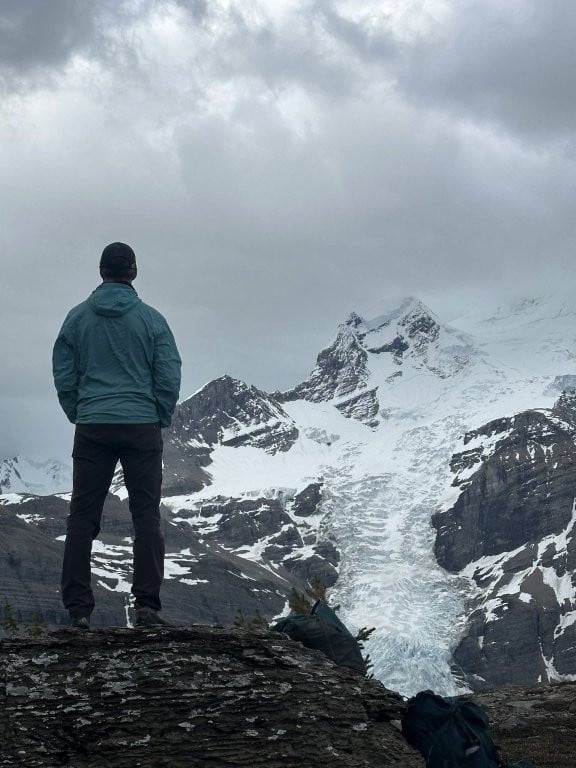
As for campsites around Berg Lake, this is how we would prioritize them when deciding which one to book:
1) Berg Lake
2) Marmot
3) Rearguard
4) Robson Pass
5) ACC Hut – we’ve put this at the bottom of the list because it is the farthest from the lake but it does offer a much higher level of comfort if you’re willing to make that trade-off.
Berg Lake Campgrounds and Stages
Kinney Lake Campground

Tent pads: 18
7 km / 175m / 1.5-2 hrs
The trail to Kinney Lake is wide and easy (except for the short avalanche spot) and very gradually uphill. As a result, it makes for a great day hike and Kinney Lake definitely flies under the radar compared to Berg Lake. Yes, Berg Lake has more spectacular mountains but Kinney is pretty gorgeous in its own right. Beautiful blue and surrounded by green hills and a few distant peaks, it is fairly protected from the wind and often calm and glassy.

It only takes an hour or so to reach the Kinney Lake Day Use area where you’ll find amazing views and several picnic tables and scenic hangout spots (making it a popular day hike destination). From there, a mostly flat path follows the shoreline around to the campground with great views the entire way.

Kinney Lake campground has a large open-sided shelter and several more waterfront picnic tables. It boasts a beautiful location and the water is shallow and often calm, although cold enough to make a grown man squeak. Most suitable for those heavy sweating types or the chronically masochistic.
Whitehorn Campground

Tent pads: 22
4 km / 250m / 2 hrs
There are two routes out of Kinney Lake campground. The main path undulates through the trees into the valley before heading up steep switchbacks to Whitehorn. This is the simplest route to take if you have plenty of time or don’t want to take any chances.
However, if it is relatively dry and the lake isn’t unusually high, you can simply follow the shore past the end of the lake and across the flat open area, joining up with the main path at the start of the valley to head up the switchbacks. It won’t save you a lot of time or effort but is a little bit more direct and flatter than the regular trail. It was even marked when we were there.
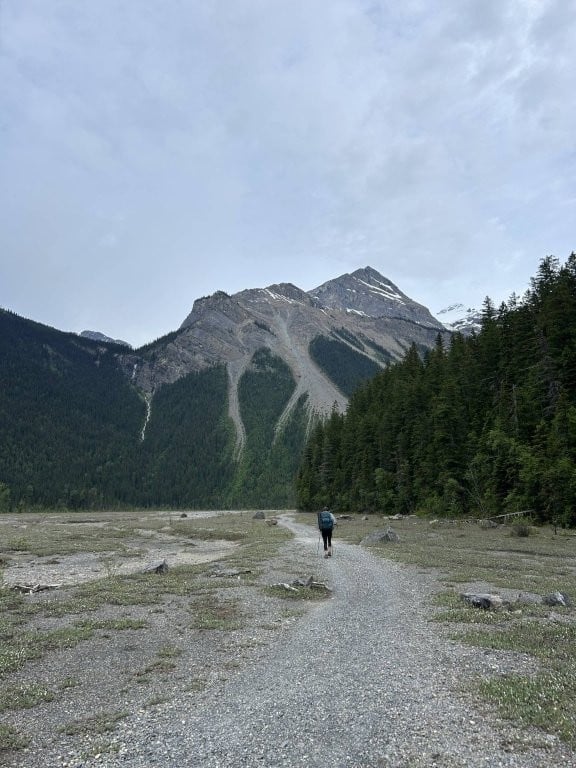

Whitehorn campground boasts a nice riverfront location with good views in both directions along the valley. Quite photogenic, although not nearly as impressive as Kinney Lake. On the other hand, camping here will make the next day’s hike to Berg Lake a lot shorter and easier.
Emperor Falls Campground

Tent pads: 9
5 km / 575m / 2-2.5 hrs
+30 min to stop at Emperor Falls (+5 min each way to Emperor Falls and 15-20 min enjoying the view)
From Whitehorn campground, you cross the newish metal bridge and follow a fairly flat (but annoyingly rocky) trail along the valley for a short while before crossing back over on another metal bridge and starting up switchbacks into a small side valley. The next couple of kilometres are the most strenuous section of the entire trek.
However, you’ll soon be rewarded with lovely views of White Falls, then 45 minutes later the Falls of the Pool and, eventually, you’ll reach the Emperor Falls turnoff. Depending on how far you are planning to split your hikes up and down, you could either take the side trip to see them now or wait until the return trip. However, if the weather is even remotely decent I’d recommend checking the falls out. They are truly extraordinary. And in any weather, really.

It only takes 5-10 minutes to reach them from the main path, although, unfortunately, you are NOT allowed to leave your backpack at the turnoff (to avoid attracting hungry wildlife). Once at the falls, we’d recommend rain-gearing up and getting as close as possible. Because of the direction of the wind, we were able to get almost underneath the falls without getting any wetter than we did 100m back at the normal viewpoint (where the wind was blowing the mist right into us).

Back to the main trail, we found the marked distances in this section to be, shall we say, bullshit. Maybe they are based on the old, pre-flood trails or something. The figures do all seem to work out in the end, with the total distance to Berg Lake matching up, just don’t believe every distance marker you read along the way.

Emperor Falls campground is fine if it’s the only one you can get a reservation for but it should probably be your last resort. There are only 9 sites and although some of them are nicely located along the river with impressive views (including a bit of Mount Robson), there is no shelter and while the scenery is nice, it doesn’t really compare to the campgrounds on the lakes.
Marmot Campground

Tent pads: 7
2.5 km / 50m / 45-60 min
Once you’ve reached Emperor Falls campground, you’ve already completed nearly all the elevation gain and it is mostly flat from there to the lake so, if possible, you’re better off continuing to Berg Lake. Marmot campground is only an hour away.
The trail follows a somewhat rough, rocky trail along a slope before crossing a flat, desolate area to Berg Lake that is criss-crossed with streams. Much of this section involves stepping stones and small bridges to avoid the water. Enough to slow you down a bit but not particularly tiring.

Marmot campground is located right on the southwest corner of Berg Lake, has a new shelter and offers the first really amazing lake views. However, it is quite tiny (just 7 sites) and the views are even more spectacular at Berg Lake campground so Marmot should remain a backup option.
Berg Lake Campground
Tent pads: 26
2 km / 50m / 45-60 min
The last 2 km from Marmot to Berg Lake campground features magnificent views of the lake, Mount Robson and Robson Glacier. Although appearing flat, there are steady ups and downs that will be more noticeable than usual at the end of a long hiking day from Kinney Lake (or the Welcome Centre).

Berg Lake is easily the best campground on the trek, which is why it is usually the hardest one to reserve. Located in middle of the lake directly across from the glacier, it has the best views and Hargreaves Shelter is a fully enclosed hut with drying lines inside, cards and games for use and tremendous views from the covered front terrace.


There is a small river that runs past (good for refilling water bottles) and plenty of picnic tables around with excellent views also. The tent pads are scattered throughout the bushes, there are 4 pit toilets (including 2 nice new ones) and lots of bear lockers. Even if you have to settle for one of the other Berg Lake campgrounds when you initially reserve, it is worth checking back occasionally to see if something opens up in this excellent campground.
Rearguard Campground
Tent pads: 6
1 km / flat / 15 min
It is a flat, easy hike to the north end of the lake to this campground. Rearguard is small and quiet and also has great views, just from a slightly different angle. Unfortunately, there is no shelter here, but it is close enough to Berg Lake that you could easily walk there if you want to cook inside out of the rain.
Robson Pass
Tent pads: 15
1 km / flat / 15 min
Beyond the end of the lake, this is another quiet, peaceful campground with fewer facilities than Berg Lake campground. There is no real shelter, just a basic lean-to and sometimes tarps fastened over a few of the picnic tables.
It also doesn’t have great lake views, although you are still surrounded by beautiful mountain scenery. And it is a good base for hiking to Mumm Basin, Snowbird Pass, Rearguard Lake and Adolphus Lake.
ACC Robson Pass Hut (Byron Caldwell Hut)
ACC Robson Pass Hut, also known as the Byron Caldwell Hut, is located just beyond Robson Pass campground and just opened in 2026. It sleeps 12 on wooden bunks (mattresses provided). There is a communal cooking and eating area with electric lights, propane heat, and a propane stove and pit toilet outside. Prices are quite reasonable ($64/bed) and highly sought after spots in the hut can be reserved on the Alpine Club of Canada’s website.
Berg Lake Day Hikes
In a perfect world, you will give yourself at least a day or two at the lake to enjoy some of the terrific day hikes in the area. Depending on your starting point, you may be able to add one the day you arrive (we came up from Kinney and still managed to get to the viewpoint that evening) but giving yourself a full day will be much more relaxed and allow you to roll with the weather as needed.
Toboggan Falls
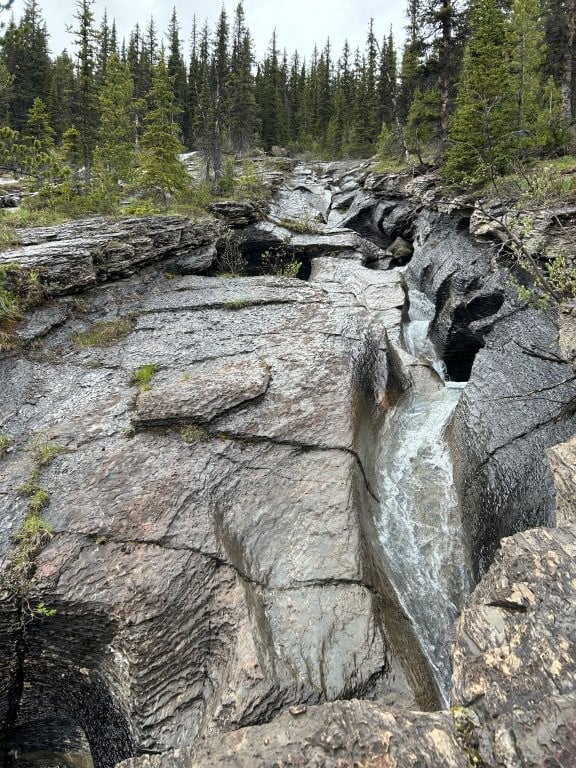
2 km / 200m / 1 hr
At the very least, be sure to make the short climb to these amazing, unique falls. You get your first glimpses just 15 minutes up the hill but if you can make it to the scenic bench at the 1 km mark, the more expansive lake views are well worth it.
Berg Lake Viewpoint

4 km / 400m / 1.5-2 hrs
You’ve probably seen some of the iconic Berg Lake / Mount Robson photos from this viewpoint. In fact, there’s a good chance one of those photos is why you’re planning this trip in the first place. So, if at all possible, try to make your way up to this panoramic vantage point. When we went in mid-June, the trail got very muddy and nasty right after the Mumm Basin / Hargreaves Lake intersection, then near the top we had to scramble over some pretty deep snow. The views, though, something else.

If you have time after reaching the top, you can head north up another rise to find a rather iconic large rock for more photos, or search around for the cave that we never did see.
Hargreaves Lake
6 km / 340m / 2-3 hrs
You can either include this with the viewpoint hike (back down a bit, then head south at the well-marked intersection) or do it as a loop of its own, with trails leading up from both Berg Lake and Marmot campgrounds.
Mumm Basin
6 km / 450m / 2-3 hrs
This scenic trail offers a more lengthwise view of the lake and used to join up with the trail above Berg Lake campground. Unfortunately, landslides have put that on hold for now, but it is still possible to do an up and back hike from Robson Pass campground.
Snowbird Pass
20 km / 940m / 7-9 hrs
This is the big one for serious mountain hikers. It is closed until the end of June to protect young wildlife so we weren’t able to do it but I’m told it is pretty spectacular. If you’re interested, you’ll definitely need to dedicate a full day to it.
Adolphus Lake / Rearguard Lake
8.5 km / 100m / 2-3 hrs
You can explore this nice area and two lovely lakes beyond the end of Berg Lake without worrying about any real elevation gain, making it a good choice for those with multiple nights on the lake.
Hiking Out from Berg Lake

As I mentioned earlier, most people will have no problem hiking all the way down in a single day, with a lighter pack than the one you started with and almost no elevation gain to deal with. Count on 6-7 hours from Berg Lake campground to the parking lot.
However, if you are hoping to squeeze in another day hike around the lake before you leave, or simply have enough time to set a more leisurely pace, you could reserve a spot at either Whitehorn or Kinney Lake on your way down.
How to Get to Berg Lake Trailhead
Located in northeastern British Columbia, roughly an hour west of Jasper National Park, Berg Lake is well-known among avid Rockies hikers but is still not a household name to the general public. Which is a bit of a surprise because, while certainly remote, it is still easily reached from a number of main destinations.
The following are some useful distances to Berg Lake trailhead:
East
Jasper – 85 km / 1 hr
Edmonton – 450 km / 4.5 hrs
Banff – 370 km / 4 hrs
West
Kamloops – 350 km / 4 hrs

Where to Stay Near the Berg Lake Trek
A lot of people hiking to Berg Lake spend a night in one of the Robson Provincial Park campgrounds before and/or after their trek. All three are fairly comfortable and scenic.
Robson River Campground
Robson Meadows Campground
Lucerne Campground
Another option is to spend some time in Jasper, where there is a long list of things to see and do, plus some excellent national park campgrounds that can be booked through Parks Canada.
Whistlers Campground

Wapiti Campground
Miette Campground
Or, if you’re like us, and the novelty of camping wears off fairly quickly, you may want to get yourself a comfortable hotel room before and/or after your trek. There are many good choices in Jasper, including the following:
Overlander Mountain Lodge has big, comfortable suites with beautiful mountain views and hikes that start directly from the property.
Jasper Downtown Hostel is more function than flash, but still clean, modern and conveniently located right in town. If you choose to stay in Jasper, you will need to buy a national park pass online or in person at one of the highway kiosks. You have the choice between paying for a certain number of days or purchasing a Discovery Pass that is good for an entire year in every national park in Canada. You do NOT need a pass to stop for gas but for any longer stay you’re supposed to get one.

Of course, Jasper isn’t exactly known as a budget destination, so if you’re looking for something a bit more economical, here are a couple good choices in nearby Hinton and Edson:
The Hinton Highway Inn has nice rooms with handy kitchenettes and good facilities less than an hour from Jasper.
After hiking all the way out in one day, we made it as far as the Travelodge by Wyndham Edson and were impressed by the service, basic but comfortable rooms and excellent included breakfast. It is also much cheaper than the options closer to Jasper.
When to Go to Berg Lake
The best time to visit Berg Lake is from mid-June to early September. It is still possible to visit outside these times but the trail is typically buried in snow the rest of the year. Most of the open trails are clear early but in shady spots the snow can linger in the trees for a long time.
We visited in mid-June and most of the trail was clear, although we did have to cross the remains of a small avalanche just a kilometre in. It was slippery but easily managed with hiking shoes and poles but we did have to help some ill-equipped day-trippers slipping and sliding around both on our way up an down.
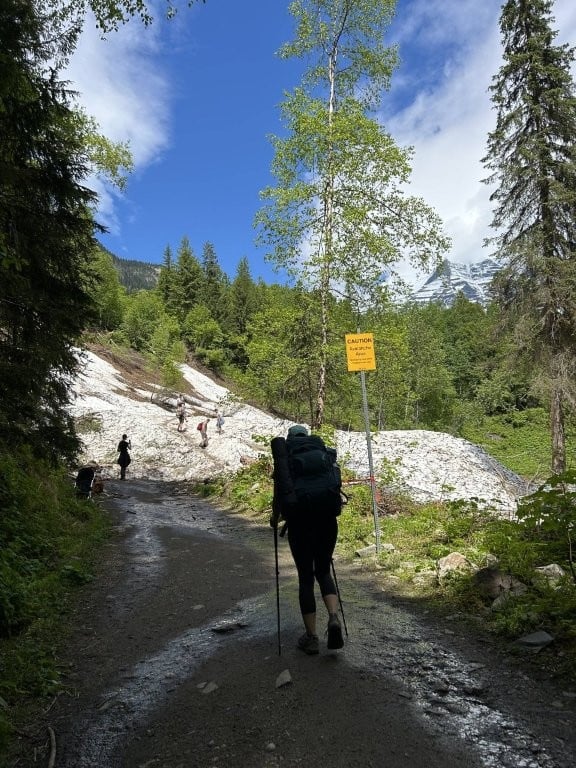
After that, we saw a bit of snow in the trees near the lake but generally the trail was fairly dry with just occasional muddy spots. The only place snow was a real issue was above Berg Lake on the 400m climb past Toboggan Falls to the main lake viewpoint. Above 1800m or so the trail through the bush was covered in snow, making the last couple hundred metres a slippery slog. Poles were quite helpful. Obviously, every season is different but I would guess that it will take until early July before that trail is completely clear. Still manageable, though, and well worth visiting Berg Lake even if it wasn’t.

Safety
Bears
Bears are the main concern when hiking and camping in the Rockies, with the general rule being:
Black/brown bears – not bad
Grizzly bears – kinda bad
You need to be careful around any bear but black and brown bears are generally just as scared of you as you are of them (which hopefully is a prudent amount) and they will usually run off as long as you make plenty of noise and don’t accidentally startle or corner them. And definitely don’t get anywhere near a cub.
Grizzlies, on the other hand, are all different but some can be very aggressive and dangerous. If you see or hear one, make yourself scarce as quickly as possible. You should always carry bear spray, also, for those situations when quietly disappearing is no longer a viable option.
Bears can appear anywhere but be particularly careful on trails through thick undergrowth and in places lush with berries (one of their guiltiest pleasures). The main things to remember are to make plenty of noise while hiking (“Hey bear! Hey bear!” has become the official soundtrack of the Rocky Mountain backcountry) and never keep food or wash dishes near your tent.
For an even more detailed set of rules and recommendations, check out the Parks Canada Bear Safety guide.
Of course, bears aren’t the only safety concern in the Canadian wilderness:
Elk
Normally safe and completely uninterested in people, they can become aggressive when they have calves or during breeding season (similar to guys in a crowded bar near closing time).
Insects
Mosquitoes, black flies and horseflies all bite but are more annoying than dangerous. Ticks can carry Lyme Disease but you don’t usually see them at high altitudes.
Water
All backcountry water should be boiled, treated and/or filtered, even when it seems clean and clear.
Weather
The weather in the mountains can change in an instant so you need to be prepared for anything. Especially in mid-summer when afternoon thunderstorms are both common and frequently violent.
Wildfire
Unfortunately, forest fires are a standard hazard in the mountains and are always a concern in summer. Heavy smoke from wildfires has become increasingly common in recent years but we were lucky enough to avoid any haze this time around.
There are no guarantees either way but it may be worth keeping an eye on the local smoke forecasts:
Canada Wildfire Smoke Forecast
Obviously, the wildfires themselves are even more dangerous than the smoke so steer clear if any are encroaching on the area. All it takes is a sudden change of wind direction to turn a seemingly safe situation into a dire problem.
And, needless to say, always be very careful not to start any fires yourself.
Summary

The Berg Lake trek is one of the great backcountry adventures in the Rockies and one that any avid hiker should try at some point. Obviously, epic Mount Robson, the tallest peak in the Canadian Rockies, is a big draw and lovely blue Berg Lake is stunning from any angle.
But what really impressed us was the level of variety on this trek. From the peaceful reflections of Kinney Lake to the awesome power of Emperor Falls to the desolate rocky plains leading up to the south shore of Berg Lake, this trek offers a lot of different landscapes and scenery. Plus, with a maximum elevation of just 1,650m at Berg Lake (and just over 2,000m at the viewpoint) the hiking season starts a bit earlier and lasts a bit longer than many of the other top lakes in the Rockies. May as well give it a go, eh?
Pin it for later!

Other Posts You Might Like:
Jasper National Park: 12 Amazing Reasons to Visit
Lake O’Hara: A Complete Hiking and Camping Guide
Floe Lake – Numa Creek Loop: An Epic Backcountry Adventure
About the Author
Dean Johnston

Dean Johnston quit his job as a financial planner in 2008 to travel the world, and has now visited all 7 continents and more than 85 different countries. He wrote his first blog entry in a sweltering internet cafe in Bali in 2000 and has been writing about their travels ever since, including publishing 3 travel books.
As Routinely Nomadic, Dean remains focused on providing informative travel guides, entertaining stories and useful social media content to readers from all over the world.