

Thailand, formerly known as Siam, is a proud and ancient nation with an endless supply of historic temples and traditional sites. Not on the islands, though, there you’ll mainly find beachfront seafood restaurants, air-conditioned bungalows and enormous mounds of discarded water bottles and Red Bull cans.
Inland, though, that’s where the good stuff is. If you’re into history. If you aren’t, well, there are still lots of Buddhas to enjoy. So many Buddhas. And if that isn’t your thing either, then, hey, what about really tall, pointy stupas? In general, they are pretty phallic, if that helps. And some are even called prangs (and the “a” is pronounced like an “o”, so, even better). And if that still isn’t enough to pique your interest, well, I recommend you check out The Best Thai Islands: An Overview.
Our site includes affiliate links to products we recommend. If you use one to make a purchase, we earn a small commission at no extra cost to you. Thanks for your support!
Meanwhile, let’s dig a little deeper into old Ayutthaya. It was founded way back in 1350 AD (right around the same time as the frying pan in our last Thai apartment). It was the second-ever Siamese capital, following in the footsteps of Sukothai, the original capital that was, sadly, stripped of its captaincy following an ill-advised hot mike situation involving a long rant about the perfect level of spice in the spicy chili sauce and some unfortunate Laotian slurs.
Which meant it was now Ayutthaya’s time to shine. And to make sure nobody forgot just how important it had become, Ayutthaya decreed its full, official name to be “Historic City of Ayutthaya”, although locals typically just referred to it as “Hissy”. We assume. It only makes sense.

Whatever your thoughts on the name, the new location was effectively strategic – on an island surrounded by three rivers that connected Ayutthaya to the sea. Not only that, but the point where the river met the Gulf of Siam was also usefully located just above the “tidal bore”, which prevented warships from attacking upriver, protected against seasonal flooding and was almost certainly a terrific place to quietly dispose of bodies. Rumour has it the kayaking was pretty good, too.
Internationally, Ayutthaya’s central location wedged between the global superpowers of India and China (suddenly the name Indochina makes so much sense) provided huge opportunities for trade, commerce and playing them off each other to receive better birthday gifts. Coinciding with the unfortunate 15th century demise of Angkor in Cambodia, Ayutthaya eagerly stepped into the void, establishing itself as the trade leader in the region. Which lasted a good while, as it has only been in the last few decades that Angkor has finally reclaimed the prestigious title of “Capital of Cheap Tuk-Tuk Tours Around Ancient Ruins”.

Employing classic Thai ingenuity and business acumen (which, at the time, was typically known as “classic Siamese ingenuity and business acumen”), Ayutthaya soon became exceptionally prosperous, growing over the next few centuries to become one of the world’s largest cities, known as a global centre of diplomacy, commerce and really tiny bananas.
In fact, Ayutthaya became such an important part of the world economy that it had ambassadors deployed in most of the biggest cities around the world, including Delhi, Beijing, Edo (Tokyo) and Versailles. Not Sydney, though, because even back then the “bogans” were just a bit much, you know? Ambassadors from these nations usually based themselves slightly downriver from Ayutthaya proper because it was quicker and easier to send messages downstream to their ships waiting in the Gulf. And probably because sometimes city chickens would fall into the river and float down to them and, hey, free chicken.

Meanwhile, the city itself was designed on a very organized and structured systematic grid of roads and canals, with defensive moats surrounding all the most important buildings and a quite intricate network of paths connecting them all. OCD did not exist back in those days but, well, maybe it actually did, now that I think about it. Ayutthaya also pioneered an innovative hydraulic water management system which greatly improved the general quality of life, despite never quite succeeding in designing a shower drain that wouldn’t get plugged by hair.
So, for all these reasons, Hissy prospered as an icon on the world scene and de facto capital of Southeast Asia for several centuries. Unfortunately, the good times wouldn’t last. Which is what we, in fake history circles, refer to as “foreshadowing”.

That’s right, just as you suspected, things took a turn for the worse in the 18th century thanks to, who else, the Burmese. Actually, it is unclear if they already had a reputation for mischief before then but, according to historians, the Siamese people seemed quite unhappy about the Burmese invading Siam and burning the “Historic City of Ayutthaya” to the ground. The Siamese cats, as usual, didn’t seem to care all that much.
Being resilient and resourceful folk, however, the Siamese eventually regained possession of most of their land and were able to rebuild Ayutthaya. After much discussion, they chose a new location that was a safer distance from the Burmese aggressors, not to mention conveniently closer to the karaoke bars and sex shops of Bangkok. Impressively, they recreated it mostly from memory, with just a bit of help from some primitive sketches salvaged from under family fridge magnets.

Which brings us to the hectic 20th century, with the Historic City of Ayutthaya representing an eclectic mix of styles influenced by many different ancient powers such as Angkor, Sukhothai, Japan, China, India, Persia, Europe and West Edmonton Mall. Its builders famously drew inspiration from these different styles and places, then added their own personality and flair. Which mainly meant making the temples a touch more phallic, then adding thousands of elephants, a lot more penises, quite a few vaginas and even the occasional set of surprising testicles. Some of the luxurious ball hair depicted suggests a distinct Mediterranean influence.
Much of what we know about the history of Ayutthaya can be traced to the fortunately preserved sets of palm leaf manuscripts found throughout the ruins (this was before you could download ebook apps on your phone). Some of which provide detailed descriptions of social structures, governmental organizations and cultural traditions. The rest are mostly just a series of crime thrillers about a hard-boiled Siamese detective who smokes too much opium but still has a knack for tracking down delinquent monks, sometimes with the help of a sassy monkey.

In 1939, Siam officially changed its named to Thailand, which translates to “Land of the Free”. They also discussed adding “Home of the Brave” but decided that it didn’t really mean much if you had to say it about yourself. Then, after WWII, Thailand got caught up in the frenzy of Allied nation-swapping and the name was changed right back to Siam. Which they rolled with for a few years until things cooled down, then in 1949 quietly switched it back to Thailand and – so far, so good – it doesn’t seem like anyone has noticed. But they’d prefer you keep it on the down-low, just in case.
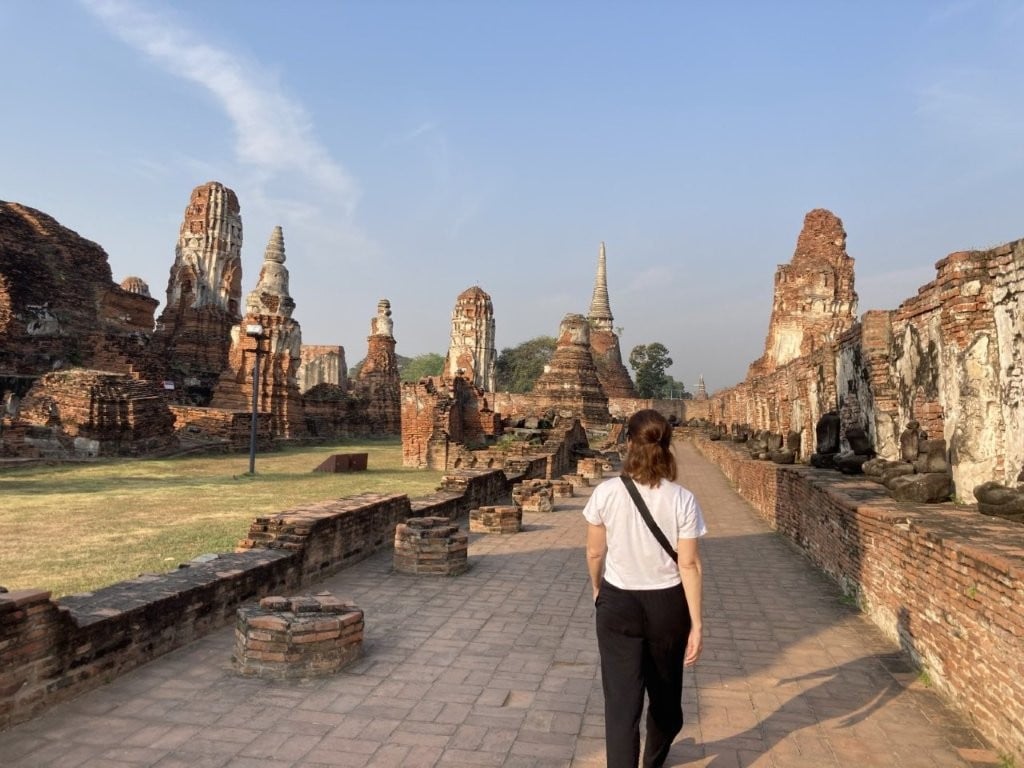
Today, the ruins of the Historic City of Ayutthaya are still expansive (289 hectares, not even counting BBQ spaces) and difficult to explore entirely on foot. Options include renting a bicycle (fun but hot), a scooter (even more fun, still hot, but you don’t notice as much) or hiring a tuk-tuk to drive you from temple to temple (sort of fun, medium-hot). Then a late afternoon 4-temple river boat tour is the way to go to see the several great spots on the river (as you might have guessed).

Now, for our guide to the main sites of Ayutthaya. Most of these sites are located within the boundaries of the former Royal Palace where, after the divorce, the King and Queen alternated weeks to provide as much stability as possible for the traumatized little princes and princesses. Unfortunately, they still ended up tragically addicted to pickleball in the end.
Wat Mahathat

The most popular temple in Ayutthaya, this large collection of ruins, statues and stupas is famous for the Buddha head grown into the roots of a tree. People come from all over Thailand to show their children, then warn them against the dangers of sticking your head through railings. Supposedly, some guy also saw a snake here once.
Wat Ratchaburana

Another extremely popular site right next to Wat Mahathat, it is known for the way its huge, symmetrical prang fits perfectly into the beautiful cleft of the welcoming entrance. In photos, of course. It is a great place to visit at sunset, mainly because it was right across the street from our hotel. If you have time you should also check out its many well-preserved crypts decorated with intricate murals accurately depicting ancient wars, demonstrative gods and babies hilariously dressed as adults.
Wat Phra Si Sanphet
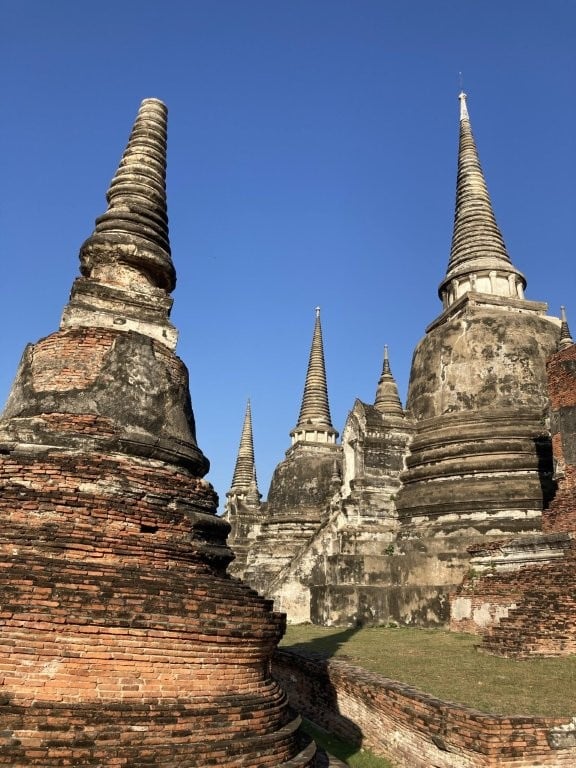
This former royal temple complex features clusters of spectacular and relatively intact Lanka-style prangs (Sri Lankan women may recognize the tell-tale pointiness). Today it is a great place for photos but centuries ago, at the height of Ayutthaya’s power and global influence, this was where the monks met to talk about rabbits.
Wat Chaiwatthanaram

An exquisite Khmer-style temple located right on the banks of the Chao Phraya River, which makes it a photogenic and popular sunset spot, as well as, theoretically, a fun place to hit golf balls into the river. It would be worth asking.
Wiharn Phra Mongkhon Bophit

A magnificent temple approached via a long, expansive walkway, you can explore inside this relatively modern structure as long as you dress appropriately. An easy trick to help you remember: No Thighs, No Rips, No Shoulders, No Nips.

Wat Lang Ka Khao

This tiny temple located at the end of a proportionately tiny bridge is in considerable disrepair, although rumour has it was one of the places the Siamese kept their meticulous collection of archived stories, legal documents, royal decrees, appliance manuals and old Boxing Day flyers. Nowadays, it’s where the ducks hang out.
Wat Langkhadum

This small temple is surrounded by a small, brick fence, which was used to protect goats during ancient times, and vaping teens in modern times.
Wat Phutthaisawan

Home to a famous Reclining Buddha, there are actually several highlights within its extensive grounds. The super-jacked chickens guarding the entrance really set the tone, followed by the Room of Excessive Bat Shit and capped off by the justifiably famous Realistic Teen-Moustache Buddha.


Wat Phanan Choeng
With a splendid location right on the banks of the Chao Phraya River, this ancient wat is home to both an objectively huge gold Buddha and the tireless man charged with cleaning handprints off Reclining Buddha’s groin.

Wat Phra Ram

This impressive stupa is surrounded by a large moat that is frequented by huge monitor lizards. It is also where they keep all the extra hair.

Summary
In conclusion, Ayutthaya is very old. Not as old as the Pyramids of Egypt. But much older than Microsoft Outlook. And you can tell just by looking at it. It is very faded, and a bit shabby, truth be told. But nobody trusts a shiny new prang, anyway, so maybe that’s for the best.
Pin it for later!

Other Posts You Might Like:
Thailand: Things to Know Before Visiting
Journal of a Thai Sleeper Train
Our Time in the Chiang Mai Markets
The Best Thai Islands: An Overview
Scuba Diving Paradise: Life on a Raja Ampat Liveaboard
About the Author
Dean Johnston

Dean Johnston quit his job as a financial planner in 2008 to travel the world, and has now visited all 7 continents and more than 90 different countries. He wrote his first blog entry in a sweltering internet cafe in Bali in 2000 and has been writing about their travels ever since, including publishing 3 travel books.
As Routinely Nomadic, Dean remains focused on providing informative travel guides, entertaining stories and useful social media content to readers from all over the world.